Full text
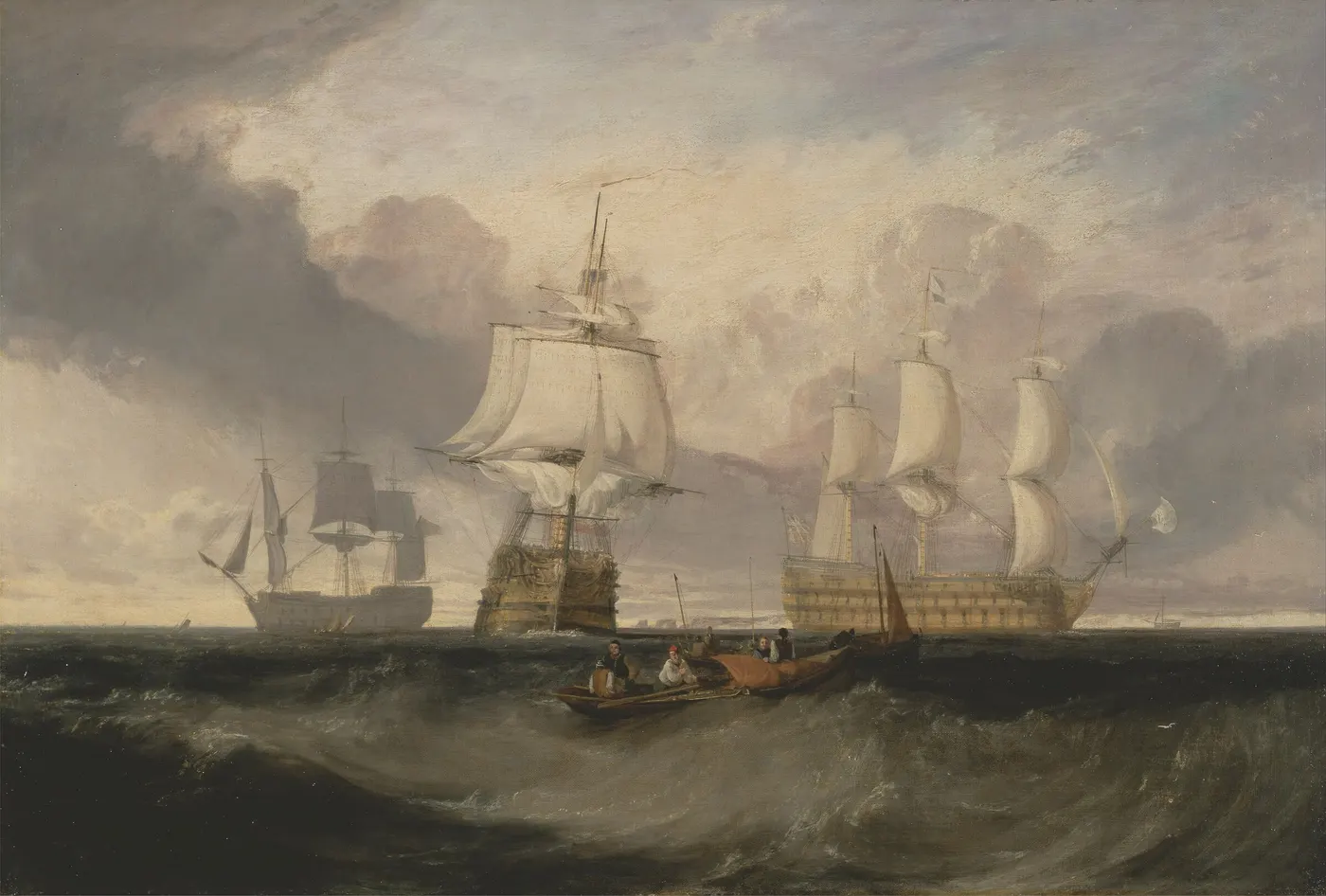
Of all the great sailing-ships of the past, the H.M.S. Victory is perhaps the best known, at least in her country. Admiral Horatio Nelson directed the battle of Trafalgar from her quarter deck, defeating the combined French and Spanish fleet and assuring British naval dominance for the nineteenth century. Also on her quarterdeck, Nelson was hit and killed by a French sniper from the mizzen top of the Redoutable. As the focus of a study, Victory is interesting for many reasons. First, the design and construction of Victory should be studied because her form represents the culmination of centuries and centuries of technological development, and the battle of Trafalgar represents the last great fleet action involving sailing-ships. Soon after, dire shortage of good wood, the invention of the screw propeller and the steam engine, and the advent of heavy, powerful guns brought an end to the era of wooden battleships and heralded that of the ironclad. Secondly, Victory has been lovingly restored to her Trafalgar condition, and is open to the public as a tribute to British naval superiority, indeed, as the very instrument of that superiority. Besides that, she exists as a memorial to Great Britain’s hero, Admiral Nelson, who orchestrated that defining engagement, and who fell tragically in its midst. Finally, for the nautically inclined, Victory is a wonderful example of a first-rate ship-of-the-line, and as the oldest surviving ship-of-the-line, deserves study in and of itself. This paper will trace developments in the design and construction of sailing-ships, beginning with the advent of the fully-rigged ship, explore Victory’s design, examine, in detail, her construction and fitting out and finally, narrate the highlights of her career.
Sailboat design in the centuries before Trafalgar
The H.M.S. Victory was a ship-of-the-line. This distinction meant that she was considered powerful and sturdy enough to occupy the main line of battle. As we will see, the size and firepower necessary to earn this label grew ever larger in the course of the eighteenth century. The story of the full-rigged ship begins earlier though, between the fifteenth and sixteenth centuries. In the first fifty years of the fifteenth century, the seagoing sailing-ship went from one mast and one sail to three masts and five or six sails.1 This period of rapid change is unfortunately very poorly documented. In an English inventory from 1410-1412, the first and only ship with more than one mast is listed. Henry V ordered a large ‘carrack’ for his Navy. This design was an adaption of the northern one-masted ship. It appeared first in southern Europe and soon spread to the north. A report from 1419 mentions that her keel is rotten and that she was only half-built. The ship was 186 feet long, with a 112 foot keel and a 46 foot beam. These impressive dimensions make her as big as any ship built in England until the end of the seventeenth century.2 The only mention of the rig in the report is a “mast beam” but this is very inconclusive. Likely the fore or mizzen mast was nothing more than a small spar. Centuries of experience with single masted ships served to anchor the mainmast squarely in the center of the boat and two-masters were never adopted in the north for this very reason. Since the mainmast was not shifted to balance the sail-plan, the addition of a single mast, forward or aft, would upset the trim of the boat. Therefore, the addition of a mast, either a foremast or a mizzen, would immediately require a third one. On royal seals from early in the fifteenth century, flagpoles on the two castles of a ship on one example from 1417 are replaced with small sails on a later seal, from 1466.
The seal from 1466 belonged to Louis de Bourbon, and it is the first dated evidence of a three-masted ship. The design appeared earlier, and many good examples can be found in a manuscript that belongs to Lord Hastings, dated near 1450.3 The ships in the seal from 1466 and the ones pictured in Lord Hastings document show a fully developed rig, featuring three masts, a bowsprit, and five or six sails. In the reign of Henry VII, inventories provide more clues about the development of the full-rigged ship. The Grace Dieu had four masts, the fourth being the after-mizzen. Appearing at the top of three of her masts were ‘tops’, separate masts that carried their own square-sail. The bowsprit supported a spritsail, and each mizzen had its’ own mizzen-sail. She carried twenty-one guns, a boat, and a bell. In 1486 she was broken up and used for the Sovereign. This ship featured topmasts, which extended above the tops and carried their own set of sails. The armament was expanded to thirty-one guns and 110 ‘serpentines’. These were very small guns that were mounted in the castles. Another ship, the Regent, had yet another mast, what would later be called the topgallant. The two mizzenmasts had tops, while the foremast had tops and topmasts.4
Toward the end of the fifteenth century the arrangement of ships’ guns changed dramatically. Instead of lining the guns on the upper deck and firing them through the bulwarks, the heavier ones were placed in between the decks, with ports cut out of the hull for them. This development, usually credited to the French, allowed for more and heavier guns, and eventually changed the tactics of naval conflict. With the coming of heavier guns, it became possible to damage the enemy from a mile away. In 1513 a ship was actually sunk from a distance by gun-fire. Increased demand on accuracy and speed led to changes in gun-design. The muzzle-loader quickly replaced the breech-loader because of its simplicity and remained largely unchanged for three hundred years.
A period of experimentation with oars swept northern Europe in the early sixteenth century. Shipbuilders tried to meld the qualities of a sailing ship with those of a Mediterranean galley in a new design called a galeass. These carried the normal square sails, but had small oarlocks below the gun ports. A document from 1549 mentions a galeass with ‘studding-sails’, which extend outward on either side of the main sails, and “a hundred oars on every side”5 The English captured two Scottish galeasses in 1544, one of them being a gift from the French monarch to James V. Henry VIII invested in the design, producing one especially remarkable vessel, the Great Galley, in 1515. This ship had four masts, two with tops, and one (the mainmast) with a togallant and was 180 feet long. She was armed with 70 brass guns and 147 iron ones. The Great Galley was clinker-built, meaning that the planking of her hull was overlapped at the seams, forming a region called the ‘land’. This method was used very successfully by the Vikings in earlier centuries, but it was not suited to the Great Galley. In 1523 the ship was broken up and replanked as a carvel (smooth sides) because “she was the dangeroust ship under water that ever man sailed in.”6 The galeass was a short lived experiment, and by the end of the century they had disappeared from northern waters.
Sailing ships became more and more seaworthy by the middle of the sixteenth century, so that both naval warfare and maritime trade became very important parts of every nations foreign policy. The fruits of discovery and commerce, and the increasingly long range of warships provided ample reason to maintain the improvement in naval technology. Sir Francis Drake’s famous voyage in 1577 included one leg of at least 8,500 miles, from Java to Sierra Leone, and in the same period, the Spanish monopoly in the Caribbean was constantly challenged by English, Dutch, and French privateers. Men-of-war and merchantmen, unlike their predecessors that were tied to the coasts, had a nearly limitless range. The changing diplomatic and military role of the warship, from the mere transport for marines to a mobile and self-sufficient fighting fortress, accelerates in this period. This process will culminate with the ability of a true naval power to flex its power anywhere on the globe, but this will only come to pass in the nineteenth century.
Ships changed little in design after the development of the full-rigged ship. In fact, the basic elements of a man-of war from the sixteenth century, one that fought against the Armada for example, are very similar to the ships of Nelson’s day. The closing of the sixteenth century saw the development of the quarter galleries, which started as balconies built across the stern, but became one of the most beautiful features of a ship in the course of the seventeenth century, only to be stripped away in the beginning of the eighteenth because of their weakness. The height of the bow and stern castles is reduced as close-quarter combat is slowly replaced with long distance shelling. Of course, even in the first World War there was a case of two battleships closing and boarding each other7, but as a rule, men-of-war tried to disable each other with broadsides before closing and going for the kill. One other important development was the advent of the beakhead, which extended below the bowsprit. Much like the quarter gallery, its’ functions were more aesthetic than structural, though the beakhead did support the bowsprit from the below and provide a prominent place for the figurehead. Elizabeth’s reign witnessed the first spurt of frivolous decorations—the English fleet that defeated the Armada was painted in bright colors and patterns—but only in the next century did these decorations reach their height. The woodcarver and the painter were given such free reign in that period that ships became ornate pieces of art that often suffered in battle for their good looks.
Although the seventeenth century saw very little change in the design of sailing ships, the period is useful to study because many reliable sources, especially images and, for the first time, models are available. Also, the elaborate decorations that were prevalent make it easy to identify the nationality of individual ships. Apart from these decorations, the main hallmark of a seventeenth century ship is the ‘spritsail topsail’. This new sail probably grew out of a flagstaff, just like the foremast and the mizzen, and was mounted on a yard near the end of the bowsprit. Its apparent awkwardness and inefficiency belies the fact that it was popular all over northern Europe for more than a century. One explanation for this sail is that the forecastle was shrinking since the early sixteenth century and a small patch of sail out in front of the boat helped to counter the windage on the poop, which was slower in receding.8 Also, as the seventeenth century progressed, the deck became much straighter, so that the dramatic sheer of the early full-rigged ships all but disappeared by Nelson’s day. Topgallant masts became commonplace, even on the mizzen, and royals began to appear at the top of the mainmast. In this era the design of warships began to separate dramatically from that of merchantmen. While warships were growing ever larger and adding sails to every mast and yard, merchantmen had few men to spare and were often quite small. Therefore their rig typically resembled that of a hundred and fifty years earlier—three masts and five sails—indeed the Mayflower carried such a rig.
Two major developments marked the beginning of the eighteenth century, the appearance of the steering wheel, followed by the advent of triangular headsails. Before the introduction of the wheel, ships were steered with a whipstaff, a drum that was linked to the tiller with rope. With the switch to the wheel, the mechanics of the system were greatly improved, so that the helmsmen could effect a much more sensitive movement. The wheel was also far safer for the helmsmen, especially in a storm. With a whipstaff, the pounding of waves on the rudder was transferred to the barrel, spinning its handles with a speed that was often lethal. When the wheel was introduced, the barrel and line was essentially unchanged, but the drum was moved to the centerline of the ship, and rotated ninety degrees so that the helmsmen worked the wheel across, rather than toward himself. A large wheel with long spokes provided much more leverage, and if the ship ‘took charge’, then the helmsmen had a greater chance of avoiding injury. The larger wheel gave the helmsman much better control over the boat, allowing him to sail closer to the wind.
The triangular headsail, or jib, was the other major development. It was adopted by the Royal Navy in 1705, immediately after the advent of the steering wheel.9 The jib was set on a jib-boom, which extended from the bowsprit. Combined with the fore topmast staysail, the jib allowed the boat to point much closer to the wind. Also, these two foresails were easier to handle than the square spritsails that they replaced. Only the largest boats kept their spritsails, but they were only used in the lightest wind, since they tended to drive the boat downwards. Victory carried yards for both the spritsail and the spritsail topsail at Trafalgar, but in later paintings the sprit-topsail disappears. In 1794 another jib was added to the bowsprit, called the flying jib. Victory also sported a flying jib, carried on the flying jibboom. The jibs were a marked improvement over their square predecessors because they were easier to handle than the spritsails and because the risk of jibing was greatly reduced. Together with the new steering wheel, the jib made it possible to sail much closer to the wind.
Apart from these two innovations, the eighteenth century saw only small refinements of the existing design, including shortening the lateen mizzen sail, coppering the hull, and the addition of studding sails. The general trend was to add sails to the rig to make it as powerful as possible. All three masts carried a full set of square sails, from mainsail to royal. These were supported by a series of masts that were stacked—the top, then the topgallant and finally, the royal—above the mainmast. The foremast staysail was not the only one, indeed, each mast supported a staysail. By 1760, many of the stay sails, which had all been triangular, became quadrilateral. The trend had some effects on the rest of the rig, for example, the shortening of the lateen mizzen sail to make room for the mizzen staysail. Studding sails were dreamed up as a means to triple the sail area of the square sails on a calm day. They were carried on studding sail booms that branched out from the yards on both sides. Methods for combating the teredo navalis changed substantially, especially on boats that spent a lot of time in the tropics, the original home of the ‘ship worm’. The worm acquired a taste for oak, and quickly bred in norther waters. The response for most of the eighteenth century was to coat the hull in a second, outer skin of wood separated from the real hull by a layer of tar mixed with hair. The early experiments with copper yielded disastrous results because the copper reacted electrolytically with the iron fastenings of the planking and the structural members with a very corrosive results. Someone figured out how to protect the iron bolt beads by 1778 because in the next four years the entire fleet was coppered, including Victory. Once the benefits of a coppered bottom were recognized, the practice was adopted by every European navy. The myriad small improvements that filled the eighteenth century did not filter to the merchant fleet because the slim profit margins would not allow heavy investment in either boats or crew. As a result, merchantmen remained small and undermanned, carrying five of six sails on three masts.
Victory’s Design
H.M.S. Victory was designed by Sir Thomas Slade, then the Senior Surveyor of the Royal Navy. This position made him the senior of two officers placed in charge of the building and repairing of royal ships.10 He was born in 1703 or 1704. By 1730, Thomas Slade owned a timber yard and warehouse. His training was academic as well as practical, including the theoretical treatises of the day and many years in the dockyards. Twelve years later he supervised the construction of two fourth-rate ships and soon after, Slade undertook the surveying and planning of the new harbor at Sandwich.11 In the mean time, he made a name for himself designing several vessels in the early 1750’s, including two 3rd-rate ships, carrying 60 guns each. His qualities were recognized and Slade was appointed as a surveyor for the Royal Navy in 1755.12 For the next fifteen years, Thomas Slade oversaw the design and construction of more than one hundred ships for the Navy. Ships built according to his plans continued to be launched even after his death in 1771. Today he is remembered as “the most innovative and successful eighteenth century naval architect, who adopted many of his designs from captured French ships.”13 In 1758, Slade was commissioned with designing a first-rate which, "he was given to understand, was to be the finest engine of naval warfare ever constructed; a nobler vessel even than the Royal George, her predecessor."14
Considered to be Sir Thomas Slade’s masterpiece,15 the design of Victory was made according with the following specifications:
| Length on the gundeck | 186 feet |
| Length of the keel for tonnage | 151 feet 3 5/8 inches |
| Breadth moulded | 50 feet 6 inches |
| Breadth extreme | 51 feet 10 inches |
| To carry on the lower deck | 30 guns of 42 pounds |
| To carry on the middle deck | 28 guns of 24 pounds |
| To carry on the upper deck | 30 guns of 12 pounds |
| To carry on the after deck | 10 guns of 6 pounds |
| To carry on the forecastle | 2 guns of 6 pounds16 |
The model for Victory was the Royal George, built in 1756, but Victory was built eight feet longer, one foot wider and 135 tons heavier. The design of ships was not a precise science and much was left to the builder. When Victory was launched, her waterline was nine inches higher than expected, an disappointing error for Thomas Slade because the gunports of the lower deck were that much closer to the water, compromising her ability to fight in rough weather. Also, when ballasting her, it was found that the port side of her hold required an extra thirty-eight tons of ballast. The importance of ballasting in tuning the trim of ships in this era reflects the human nature of construction methods: the port and starboard sides of a ship would not always match. Above all else, Victory was renown as a good sailer. Large first and second rate ships had reputations for being hard to handle and slow, but Victory was an exception to the rule. Her ability to keep up with the smaller, fifth and sixth rate ships made her a popular choice as a flagship.
Victory’s classification, first-rate, represented the largest and most powerful ships of the period. Three of Victory’s decks are occupied principally by the hundred-some guns that make up her primary armament. The lowest gundeck is the strongest and carries the heaviest guns. Companionways, pumps, hatches, and capstans are lined up along the centerline so they do not interfere with operating the guns. On the middle gundeck, removable bulkheads are fitted aft to create private cabins for officers, and above, the Admirals cabin takes up nearly a third of the upper gundeck. Like the officers and the men, the Admiral slept between two cannons, though his hammock was more luxuriously appointed. The quarterdeck extends above the after-end of the upper deck. It is lightly armed and housed the Captain’s quarters, a cabin for his secretary, and the office of the ship’s master. Just forward of the mizzenmast, under the edge of the poop, stands the wheel and the binnacle. The poop was not designed to carry heavy guns and is of very light construction. It provided an area for working the mizzenmast, a place to store the signal flags, and a place for marines to shoot from in battle. The forecastle rose like the poop above the forward part of the upper deck. It provided a platform for working the main and fore masts.
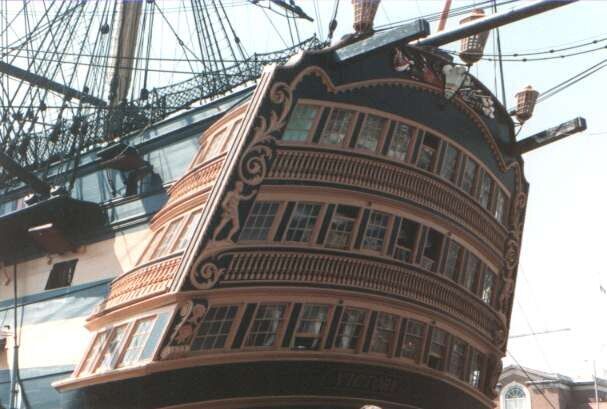
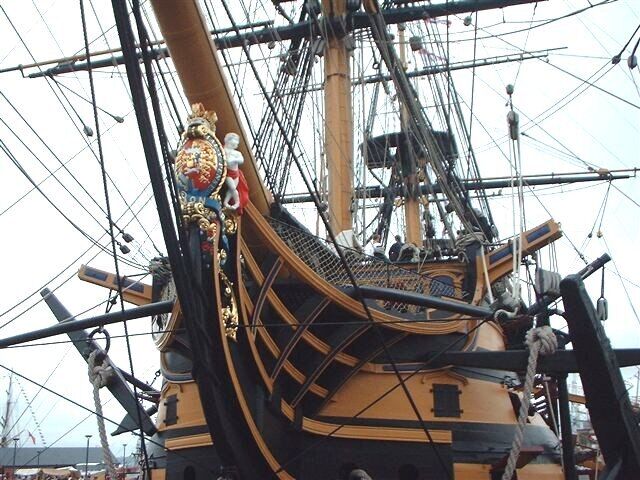
Starting from the bows on the outside of the hull, the most prominent feature is the beakhead (see Figure 3). Serving a purpose that is at least as ornamental and aesthetic as it is structural, this built-up timber ‘cutwater’ extended outward from the stem and supported the figurehead. Spaced between every other frame, gunports lined each deck. The center port on the middle deck, adjacent to the main mast, is sacrificed for an entrance, complete with elaborate moldings and the ships ladder. Chainwales were fitted at the upper deck to support each mast’s shrouds. Wrapped around the stern are the ornately carved and windowed quarter galleries. The decorative touches that were so prevalent in the Baroque era were strictly restrained in the later half of the eighteenth century. Victory began her life with a very elaborate figurehead and quarter galleries but during her 1803 refit many of the carvings were stripped away. (see Figure 2) Victory carried four boats on her boat booms. These were exposed beams forward of the quarterdeck. The boats were arranged in chocks and secured when under way. The main hatch, used for loading provisions into the hold, was at the after-end of the opening. Walkways led along the side of the hull, connecting the quarterdeck to the forecastle. The largest boat was the thirty-four foot launch that could be rowed or sailed. This boat was used to load stores, handle the anchor, and even transport the ships cannons. The other ships were smaller; the barge was thirty-two feet and reserved for the Admiral, the pinnace was twenty-eight feet and used for senior officers, and the cutter was only eighteen and used for emergencies.17 The boats were launched by rigging tackle from above. immediately forward of the booms stood the ship’s belfry. This was ornately decorated with oak leaf scrolls and carried the ship’s bell.
A full crew for a ship of Victory’s size was 850 men, but this figure fluctuated depending on availability of men. At Trafalgar there were 816 men on board. The crew’s accommodations were on the lower deck. Each man received a hammock with he joined the ship, and was assigned fourteen inches to hang it in. Hot food was prepared in the ship’s galley, forward on the middle deck. The sickbay was directly in front of the galley, and was presumably kept warm by the stove. Toilet facilities for the crew were out on the beakhead, all draining directly into the sea. The officer’s wardroom occupied the after end of the middle deck. The wardroom served as a dining room and a place for entertainment. It housed seven private cabins, a pantry, and toilets. The master gunner and his assistants occupied the area surrounding the tiller, one deck below the wardroom. Their cabins where necessarily small to allow the tiller its’ free sweep. The carpenter and the boatswain occupied cabins forward on the orlop deck. Toward the stern on the orlop deck, a series of permanent cabins housed the surgeon, the steward, the purser, the midshipmen’s berth, and various storerooms. The Admiral’s quarters were above the wardroom on the upper gundeck. His accommodations included a day cabin, a dining cabin, and a sleeping cabin. From Nelson’s dining cabin, a narrow companionway leads up to the quarterdeck. Outside his quarters was an office for the clerical staff. The captain had his cabins above the Admiral’s quarters, on the quarterdeck.
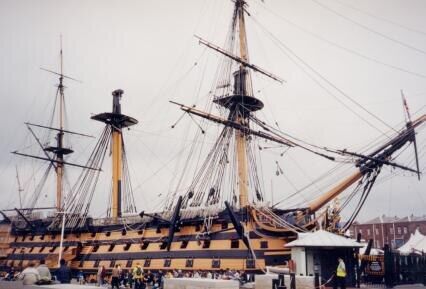
Rising above her decks, the three masts are identical in construction, and vary only in dimensions. Each mast is composed of four parts: the lower mast, the topmast, the topgallant mast, and the royal. Only the lower mast is permanently fixed to the hull. The masts are made of fir because it has good flexing properties. The lower masts are three feet in diameter, two for the mizzen, so they had to be scarphed together from many trunks. To keep the pieces together, the masts were wolded at three foot intervals with binding rope. During the 1803 refit, these were replaced with maintenance-free iron bands.18 The lower masts are braced at each deck with beams and wedges driven around them. The topmast is fixed in a bracket called a cap at the top of the lower, where trestletrees and crosstrees serve to brace the topmast from all sides and form the frame for a platform. Shrouds that support the topmast pass over the edge of the platform and terminate at the lower shrouds. The topgallant connects to the topmast with an identical, though smaller, fitting. No platform is laid across the trees but they support another set of shrouds for the topgallant mast. The royal was only an extension of the topgallant, but it is referred to with its’ own name. All the upper masts were hoisted into position with sheaves at their lower ends. Victory’s bowsprit was scarphed and wolded together just like the rest of the masts. It is extended by the jibboom, fitted on the end with a cap. During a refit in 1795 a flying jibboom was added to the end of the jibboom. The yards that support the square sails are named for the mast that carries them. They were made of fir and in the same way as the masts. At their middle section, they had eight or sixteen sides, depending on their size, and at their ends they were rounded. Yards on the fore and main masts had iron fittings to support studding sails. The mizzen mast was originally lateen rigged, but in 1797 it was rebuilt so that it carried one yard, called the cross-jack yard, and a gaff rigged sail called the spanker. The masts and yards of a ship-of-the-line were very vulnerable to damage in storm or battle, so spare spars were carried alongside the boats on the booms.
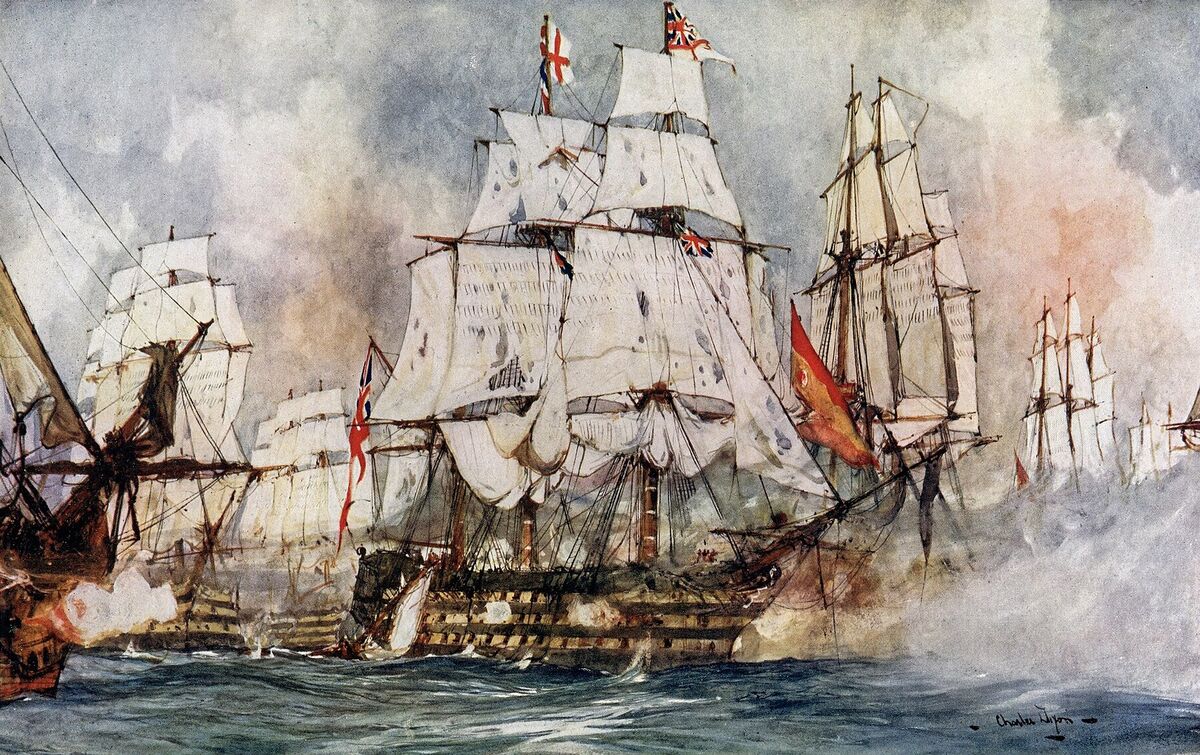
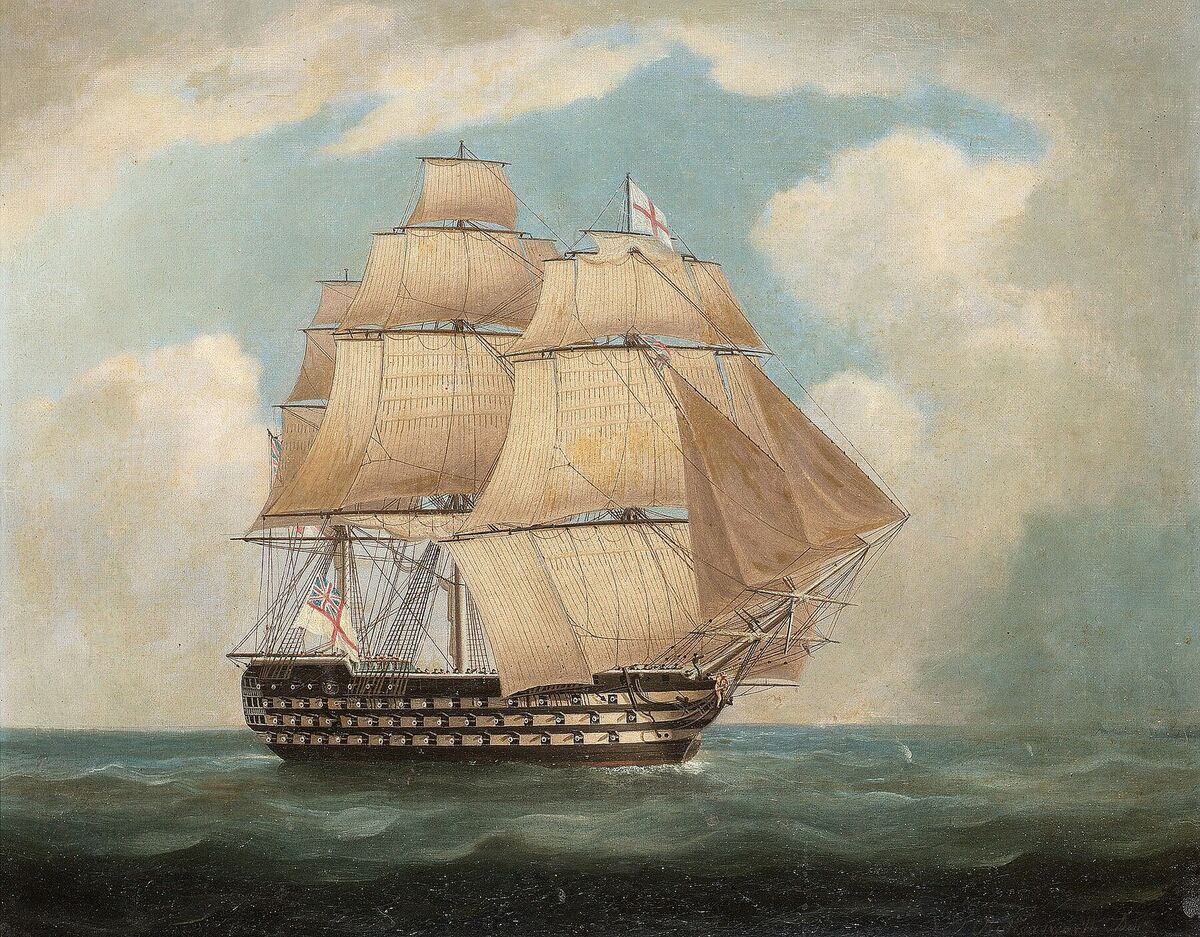
On the lightest day, Victory could spread thirty-four sails on her yards. There are two rough categories for her sails, square (quadrilateral) or fore-aft (triangular). Square sails were set from yards on the masts, set in order from the base: main sails, topsails, and topgallant sails. Triangular sails were carried in between the masts and tacked at the bowsprit. Four, two jibs and two staysails, were strung between the foremast and the bowsprit. Four staysails were rigged between the foremast and the mainmast, and only three between the mainmast and the mizzen. Studding sails could be added to the fore and main yards if conditions were peaceful enough. (see Figure 1) The sails were sewn together from two-foot strips of canvas. The bos’n had a sail-maker with a crew of assistants under his command to produce all these sails. In higher wind, only the topsails were used, so these were made from heavier canvas and had four reefing points. Square sails were attached to yards with robbands, short lengths of rope sewn into the canvas.19 Generally speaking, the square sails served as the power plant, while the staysails improved the windward performance by balancing the rig. The most crucial sail for upwind speed was the spanker, because it drove the bow up into the wind. The rudder was not large enough to provide steerage on its’ own so a balanced rig was necessary to save the helmsmen from expending all his energy arguing with the boat.
Victory’s construction and Fitting-out
The keel of Victory was laid in dry-dock on July 23, 1759.20 The ‘Old Single Dock’, one of the bigger dry-docks in the Chatham Yard, was chosen because it was near the Admiral Superintendent’s house. The keel was made of teak, twenty inches square, to a length of one-hundred and fifty feet. The pieces were carefully fitted together and bolted so that they took the form and strength of one. A ‘false keel’ was attached to the underside of the teak to protect Victory during construction and a great roof was added to the ‘Old Single Dock’ to shelter the workers and to protect the growing skeleton from the rain. At the front of the keel, the stem post was added. Just like the keel, the stem was scarfed together from many pieces of wood. The stern post was added at the opposite end of the keel. Because the stern post had to support the heavy strains of the rudder, it was fashioned from a single tree with the appropriate curve.
After the length of the keel was complete, the frames of the ship were assembled. These had to be very strong, yet they had to fit the curves of the hull as described in the drawings. At the center of the ship and near the masts, the frames were spaced very closely to support the stresses of the rig, the weight of the guns, and all the gun ports. Trees with the appropriate curves in them had to be found for each rib, while especially straight ones were needed for the beams that would support the decks. Each frame (a pair of ribs and the beam that spanned their tips) was built up on the floor of the shop. Then it was lifted and fixed into its’ place on the keel. With the skeleton complete in just over a year, the ordinary practice was to leave it out in the weather for the second year to season the wood thoroughly. The original building order from the Admiralty urged haste and required that the ship be ready for the sea in thirty-three months but, in 1760, a string of English victories in the Seven Years War relaxed the urgency of the Admiralty’s situation, and the skeleton of Victory was left to weather.
John Lock and Edward Allin served as Master Shipwrights at Chatham Yard while Victory was built. This position made them responsible for supplying the enormous amount of timber needed to complete Victory. All sorts of trees were necessary, though the most sought-after was British oak. A first-rate ship of the line was expected to require 300,000 cubic feet of lumber.21 Prime oak trees were over 100 years old, and between 2,000 and 2,500 were consumed in the construction of Victory. In this manner, fifty or sixty acres of forest were leveled.22 Near the end of the eighteenth century, the supply of British oak was dwindling. This shortage, combined with the development of powerful guns, the steam engine, and the screw propeller, brought about a revolution in naval architecture: the ironclad battleship.
The planking was laid over the ribs like the skin of a kayak over its’ frame. The outer layer was made eight inches thick, while the inner measured five inches. These two layers of planking, plus the ribs, protected the gunners of Victory with an oaken wall two feet thick. The wood was prepared a year earlier, and stacked in the yard with battens between the boards to season the wood. Treenails, tough little oaken pins, were used to attach the planking to the ribs. In the bow and stern of the vessel, where the curve of the hull was especially tight, block and tackle and hot steam was needed to wedge each board into place. Beams were added to support each deck. In the bow and stern, each beam was built out of two oak trunks, but near the masts and toward the middle of Victory, three trees were necessary to span the width of the deck and to support the guns and masts. The decks were laid over the beams and fixed in place with treenails. To seal the hull against water, oakum caulk was hammered into the cracks and seams. Oakum was made out of unraveled old rope, lacquered with tar and hot pitch. The seams in each deck were sealed in the same fashion. From time to time, when the oakum needed repair, caulkers were sent down each side of the hull and up and down the decks with a bucket of pitch and a chisel.
Six years after the order arrived at the Chatham Yard, Victory’s hull was largely complete. On May 7, 1765 the celebratory champagne bottle was sent smashing into her bows and the ocean was let into her dry-dock.23 Though the masts, sails, and rigging were missing, flagpoles were put up in their stead. The forward pole flew the Admiralty flag, while the Royal Standard flew in the center, and the Union flag of Britain flew on the mizzen. Already the war for which she was commissioned, the Seven Years War, was at an end, and a new King, George III, sat on the throne. Victory floated at the Chatham Yard, awaiting completion. Though the paintwork of her Trafalgar days—the broad stripes of black and yellow—are relatively famous, little is known about her original color-scheme. The norm for the era was to paint the hull below the water line white, like the underside of a fish, followed by a belt of black at the waterline. The topsides wore a dull yellow, intermixed with varnish. Louder colors like blue, scarlet, and even gilt, were used for the bow, and especially the stern. The masts were painted the same yellow as the hull, while the spars were almost uniformly black. The cabins and the wardroom were fawn-colored, but the gun-decks were always painted red to disguise the carnage of battle. When the gun-ports were raised, the fifty-odd patches of bright red on each broadside created a striking effect.
Though some measure of restraint was imposed in the painting (green was almost never employed because of its expense) of the ship, the figurehead sculptor was given free reign. The original figurehead for Victory was a very large and elaborate affair, measuring twenty-four feet long, eighteen feet wide, and twelve feet high.24 A bust of the King was at the center, with a laurel wreath on his head and wearing a coat of mail. Below him, a great shield bearing the royal arms was supported by cherubs representing the four winds. Beside the king’s bust, Britannia appeared trampling underfoot the figures of Envy, Discord, and Passion and receiving the chaplet and palm of victory from Peace. The British Lion crouching behind her, along with representations of Europe and America. This side of the figurehead was supported from below by a genie holding an assortment of fruits and flowers. Victory appeared on the other side of the King. She held a crown of laurels in her hand, while keeping Rebellion, a hydra with five heads, under foot. Surrounding her were figures of Fame blowing on a trumpet, and figures of Africa and Asia. Another genie supported this half of the figurehead, this one holding a compass and a globe.
The figurehead was fixed at the end of the beakhead, just below the bowsprit. The original form of Victory’s bow, with a square bulkhead at the stem and the elaborate beakhead, was quickly replaced with a continuous curve after Trafalgar demonstrated its’ weakness. Whatever the beakhead lacked in strength though, it certainly made up for in beauty. The beams it was made of were bent into gentle curves that intertwined and rose from the stem. Carven mermaids made their home among these beams, as did knights and apostles. Underneath the rails, Cupids rode on dolphins, blowing on trumpets or holding Britannia’s spear and shield. Together with the figurehead and the elaborate basketwork of the beams, these figures created a shrine to the ocean and to British sea power.25
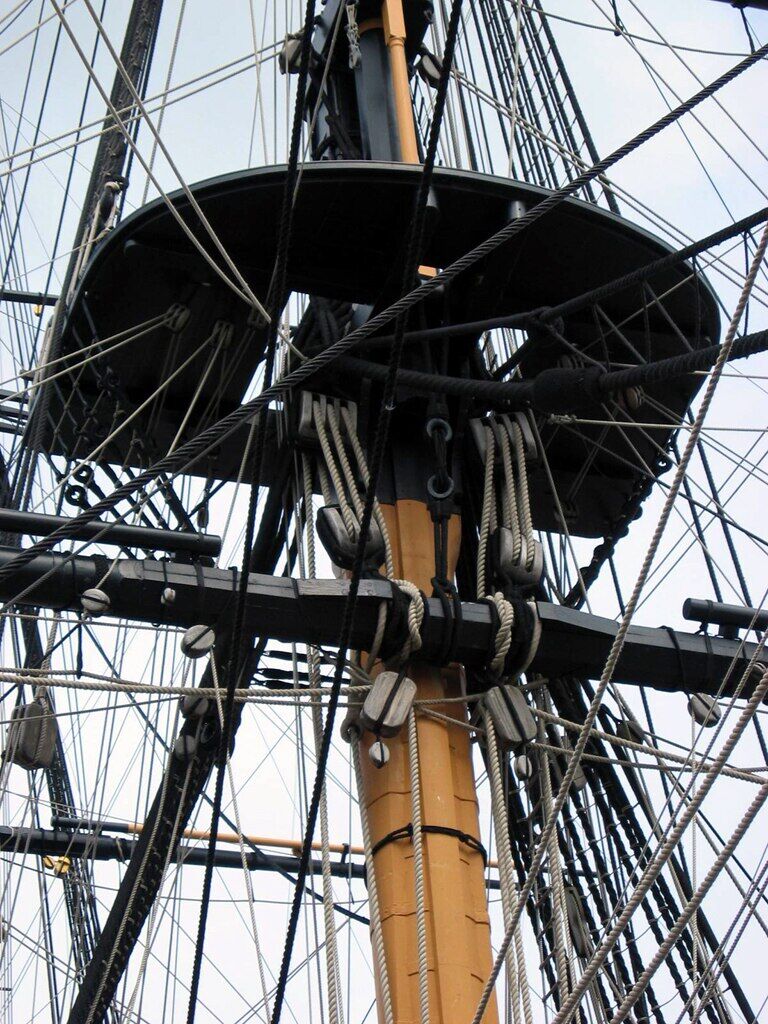
When Victory was launched, she was pulled out to one of the sheer hulks in the harbor. These were vessels designed for stepping masts. They were fitted with big cranes and powerful derricks, larger versions of the capstans that ships used for lifting anchors and raising topmasts. This special equipment was needed to raise the lower masts because they were much larger than the other masts. They measured more than six feet around and were stepped on the keel, through all the decks. Unlike the other masts, the lower masts were permanent fixtures, supported by a mass of rigging. As many as fifteen shrouds led to each side, where they ended at the chain-wales, while stays led fore and aft. Ratlines traversed the shrouds and provided access to the top for sailors. The upper-masts were supported by another set of shrouds that extended upward from the top. A smaller cap at the tip of the top mast supported the topgallant, which in turn had an even smaller cap at its tip for the royal. A smaller platform at the base of the topgallant provided a base for the shrouds that supported the top of the mast. (see Figure 6)
With the lower masts in place, Victory was released from the dockyard and turned over to her first captain to complete her fitting out. The cost of her construction thus far totaled 57,748 pounds.26 The newly-appointed captain and his circle of warrant-officers was responsible for equipping the H.M.S. Victory with all the things necessary for sea. Warrant-officers were assigned to Victory by warrant, rather than by commission and as such they were by no means the captains’ equals. They were responsible, between the six of them, for keeping Victory operating smoothly. Since Victory was but a hulk with three stubby masts, fitting her out was their first task. Their titles were the master, the gunner, the boatswain, the carpenter, the surgeon, and the purser.
The master’s main role was to safely take Victory where ever the Captain directed. The master was a product, invariably, of the Blue Coat School.27 He would have studied for a strict series of examinations in subjects like nautical astronomy and pilotage before receiving his certification from the Trinity House. If successful, he would become a Younger Brother of the house. The Trinity House was founded by Henry VIII in 1514 and is responsible for the care of lighthouses and serves as a charitable organization for mariners. The master was also responsible for navigation; the tireless attention required for accurate dead-reckoning would be his, with one eye constantly trained on the sand-glass, the sails, and the shifts in wind. If there were no charts, than he made them. Finally, every observation and calculation was entered into the logbook with precision. Many of these logbooks survive, and they provide a very dense but interesting source.
Beyond the business of sailing Victory, which there was little of to do while she was fitted out, the master was also responsible for the loading of stores to ensure proper trim. He oversaw the loading of nearly three hundred and seventy tons of ballast. Ballast in this era was made of a mixture of iron and shingle. Shingle was cheaper, but it shifted easily and often caused damage to the hull. A certain ratio was standardized, and the master would check to make sure he was getting his share of iron.28 Four hundred tons of water, one hundred tons of fuel, and three hundred tons of provisions were laid down in the hold. The master had to arrange the stores so their slow consumption would not unstable the boat. In other words, there had to be an equal number of water barrels on each side of the keel, and an even distribution along the centerline. Otherwise, three months later, the boat might have a list to one side or another.
The gunner had the great task of arming Victory with over a hundred guns. First, he had to organize the installation of all the gun-carriages. Then he had to procure the guns from the arsenal and have them mounted on their carriages. The gun tackles, rammers, and sponges had to be organized for each gun. After the guns were installed to his liking, the gunner had to see about loading the powder and the shot. More than one hundred tons of iron balls were loaded into the hold of Victory. Several dozen were arranged in shot-racks near the guns in case a sudden need arose. These were exposed to wind and water, and quickly rusted, so that they had to be cleaned regularly. Loading the powder required much more attention. Victory had two magazines, both located far below the waterline in the depths of the hold. They were accessible only by their own companionways. These were covered in copper hatches and locked. Only the gunner was allowed to enter, and he did so with felt covered shoes. Both magazines had water reservoirs so they could be flooded at any time. The magazine in the bows held the mass of powder in strongly coopered casks, while the after, or hanging magazine, only held prepared shot for immediate use. In addition, the gunner was responsible for the small arms. His office of sorts, the armory, was located at the end of the lower gun deck. In lockers on the floor, on racks surrounding the mizzen mast, and all along the rounded stern of Victory were kept all the small arms and ammunition: muskets, pikes, blunderbusses, pistols, cutlasses, and tomahawks. The whole space was isolated from the rest of the ship by a network of bulkheads. Because he was responsible for so many things, the gunner had under his command a series of subordinates. For example, there were a great number of quarter-gunners, each one responsible for the operation of four of the great guns. The armorer was placed in charge of the gun room, and he spent his days keeping the weapons bright and clean.29
Of all the warrant officers, the bos’n was most occupied while Victory was fitting. The lower masts were installed by the dockyard, but the rest of the rig was his responsibility to organize. Masts and yards had to be ordered, inspected, and hoisted into position. The enormous tangle of blocks, halyards, braces, buntlines, and cordage had to be sorted out and installed. Each chord of sail canvas had to be ordered, inspected and stitched into sails. The bos’n was also given command of the sail-handlers. When the captain or the master suggested that sail be reduced, the officer of the watch made the order, and finally, the bos’n carried it out. His whistle was the badge of his authority. It would call for all hands on deck, or which sail to furl, even in the loudest gale. The bos’n was also trusted with the anchors. Victory had several, but three were always ready to set. The anchors were stowed on either side of the forecastle, where large beams called catheads stuck out over the water. The catheads were fitted with heavy tackle to raise the anchors. The anchor line was perhaps the greatest source of anxiety for the bos’n. It was a hempen line, twenty-five inches around, and more than one hundred fathoms long (six hundred feet).30 Every time the great cable was brought into the ship, the greatest care was taken to dry it out because if it was put directly into the hold, then it would likely rot. Each of Victory’s cables cost four hundred pounds, and the bos’n was responsible if any harm came to them. Also, the security of the vessel and all those on board depended on her ability to anchor securely. When the anchors were set, the anchor rode was secured to massive cleats called bollards on the gun deck. These were part of the ships frame and faced the howse-holes in the bows through which the cable passed. When the anchor was weighed, the capstan was manned and since the rode itself was too large to fit around, an endless line called a messenger was used. Capstan-bars were manned like the spokes of a wheel and sailors pushed and pulled the barrel around, and the anchor out of the water. Since his position had so many responsibilities, the bos’n also had a small staff. The most important were the sail-maker and the rope-maker, and both were always busily employed. The bos’n had a cabin and a storeroom forward on the orlop deck.
Just as the bos’n was given charge of the rig, the carpenter was entrusted with the hull. His position required a very comfortable working knowledge of carpentry, shipbuilding, and sailing. Before obtaining the warrant for his position, he was required to demonstrate these proficiencies. Most of his work was done in emergencies, when storm or battle left Victory wounded. Then he was expected to erect a jury rig if the masts were blown away, or to patch any damage to the hull. The carpenter kept an eye on the water level in the hull, and often he would suggest to the captain that all hands should be sent to the pumps. While fitting out, he had the duty of checking all her timbers, ribs, beams and the knees, and replacing any rotten or missing pieces. He was also responsible for the caulking seams, the topmasts, and the spare yards. In such a large and complex ship as Victory, he was constantly busy renovating, repairing, or touching up paintwork. His cabin was next to the bos’ns in the forward part of the orlop.
Though the conditions aboard Victory were much improved since the days of the Armada, the surgeon always had his hands full at sea, and especially in battle. To obtain his warrant, he had to pass examinations as both a physician and as a surgeon. His realm was the sick bay, located at the front of the main deck, underneath the forecastle. His assistants included two other surgeons and a crew of attendants. At sea, the swarms of men that occupied every nook, cranny and small space on board, combined with a chronic shortage of fresh food and water and the lack of ventilation below decks kept the surgeon and his assistants busy. When the captain made rounds, the surgeon often accompanied him, pointing out hygiene issues and excusing men from duty because of sickness. To combat illness and squaller, the surgeon could order the whole ship washed in vinegar, have sulfur burned in the hold, or have every man washed with soap and water.
Finally, the last of the warrant officers, and the least-liked by the company, was the purser. The purser was responsible for the provisions of the ship. Of the warrant officers, he was most likely to be a man of wealth and power. Most of the things placed under his control were easily sold for large sums of money, so the Lords of the Admiralty required a large deposit against the chance that the stores somehow disappeared, hence why the purser was a man of some means and wealth. He cared for all the food, spirits, and clothing and was charged with rationing them out to the men. His quarters were at the after end of the orlop deck.
Soon after the warrant officers set upon their work, the sailors started to come aboard. As the men came, in two’s and three’s, they were divided among the officers, placed under the command of petty officers, and set to work. A few weeks after launching, Victory was a swarming hive of activity. Men worked on sails, finished the deck, ran rigging, spun rope, and made hammocks. After everything on deck was complete, the decks were sanded and tarps were thrown over all the painted work so that the rigging could be tarred. The stays, shrouds, ratlines, and anything liable to rust, including the guns, were tarred with the finest Stockholm tar. When the rigging dried, sails were sent up to the yards, and Victory hoisted the “Blue Peter” to show that she was ready for sea.31
Victory was built, just like every ship before the nineteenth century, out of wood, hempen line, and canvas made from flax. Therefore, no matter the care and expense that was invested in her construction, she began to deteriorate as soon as she was launched into her wet and salty world. English oak was the best wood for shipbuilding because it was so hardy and preformed well under these conditions, but it was also the favorite food of the ship-worm and the gribble. Neither will directly undermine the structural strength of the ship, but their constant gnawing will accelerate the deterioration of beams, planking, and frames. One of the most popular responses to the pests was to sheath the whetted surface in copper. Not only did this solution cause disastrous electrolytic reactions, but it often hampered boat speed and did not always prove effective. Many of the joints in the depths of the ship were almost completely isolated from the air, and when water seeped down into hull, the lack of air made the timbers rot. Because of the endless variety of destructive forces that befell a wooden ship on the ocean, dockyard repairs were a frequent event. Whole timbers were ripped out of the hull if they were rotten. Often only the ends needed to be cut back and replaced with new wood. As the timbers dried out and shrank, the fastenings worked loose, allowing more water into the hull. The masts, spars, and rigging were also regularly checked for decay.
Victory’s Career
When France joined the War American of Independence, Victory received her first commission, which lasted four years. As she prepared for war, she received King George III with a twenty-one gun salute. She first saw action off Cape Ushant in July 1778.32 Under the command of Admiral Keppel, the English fleet chased down a French squadron under Admiral Compte d’Ovvilliers that broke through the blockade at Brest on July 8th. The pursuit went out into the Atlantic for two weeks before the fleets closed. Finally on July 27th the British vanguard exchanged shots with the French rear. Victory focused on the Bretagne, the French flagship. At 1 pm on the 28th the British wore off because of damage sustained to the rigs. An hour later Keppel signaled to line up bow-to-stern for repairs. Soon after, the French fleet bore down, scattering the British into a confused disorder. The British fleet organized itself and made for Spithead for repairs. Victory saw little action for the next two years, though she was refitted three times, including a coat of copper for her undersides.33 In 1781 Victory was involved in the capture of a French convoy at Ushant. In the next few years her commanding officer changed a few times, but she saw little action. In 1783, serious structural damage caused by the coppering was found. The subsequent repair was one of her more expensive, totaling 15,372 pounds.34
The next major action for Victory came in 1793, right before England declared war on revolutionary France. She went through a quick refit to make her seaworthy and was placed under the command of Admiral Hood. Victory sailed for Toulon with a large force to blockade the French Fleet and relieve the siege of the city. Supported by the allied Spanish fleet, Hood captured many French ships to keep them out of the hands of the revolutionaries. On August 26th, he tried to land a force to capture Toulon, but even the combined, Spanish-English force was unable to hold the city, which eventually fell to the revolutionaries in December.35 Victory remained in the Mediterranean supporting attacks on revolutionary forces at Bastia and Calvi. Late in 1794, Admiral Hood retired because of deteriorating health. He transferred command of the fleet to Admiral William Hotham in Britannia (another 100-gun) and sailed home in Victory.
Rejoining the Mediterranean fleet flying the flag of Rear-Admiral Robert Man, Victory was taking on water with the rest of the British fleet when the French fleet broke through the blockade and made for sea. Hotham quickly gave chase, though heavy weather on the first night kept both fleets from engaging. By the next noon the wind was calm, and the French fleet began to line up. Then, “1/2 past 12 the wind shifted from SWW to North which brought the enemy’s sides to bear on us when the three Ships of the [French] Rear began to fire.”36 The two fleets exchanged fire for two hours before Hotham ordered the retreat. From Victory’s log, “ordered the retreat to be beat to repair our rigging not being able to make Sail having lost the fore topsail yard main mop gall. All the masts wounded with the main stay cut away sever of the shrouds all the braces and running rigging.”37 After the engagement, other captains and officers criticized Hotham’s decision to retreat. This error eventually cost him his position. Victory and the rest of the English fleet sailed for San Fiorenzo for repairs. By the end of the year the French were in control of the Mediterranean, forcing the British fleet to retire to Lisbon. Under a new commander, Sir Robert Calder, First Captain to the Fleet, the British fleet gave chase to a Spanish convoy carrying mercury from the Americas. Calder directed his flagship directly into the Spanish line, effectively dividing their forces and turning the battle into a free-for-all. The British captured many prizes, thanks in good part to the action of Nelson and Collingwood, who chased down several Spanish ships at the end of the battle. Victory sailed for England with a Spanish prize in late August. In the remainder of the year she was converted into a hospital ship for prisoners of war.
At the turn of the century, Victory was completely refitted at a cost of 70,933 pounds. The repairs occupied three years. Once the repairs began, many defects were discovered, for example, more than half of her knees needed replacing. Also, the open quarter galleries were torn out and the stern was closed in. The magazines were updated with lead and plaster as anti-flash precautions. Because the original figurehead was rotten, it was replaced with the lighter, simpler design that still exists today. Two new gunports were added in the bows and the ship was painted in her Trafalgar colors. The combined weight of Victory’s broadside was 1,092 pounds, comprising thirty 32 pounders, twenty-eight 24 pounders, thirty long 12 pounders on her upper gun deck, twelve short 12 pounders on her quarter deck, and two medium 12 pounder carriage guns and two 24 pounder carronades on her forecastle. In 1803, hostilities with France were predictable, so Victory was fitted for sea.
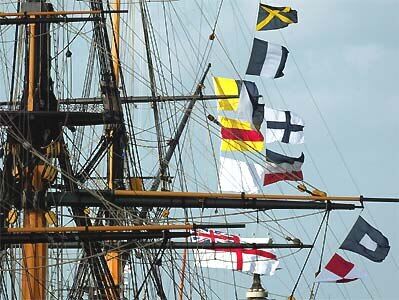
Victory is best known as Nelson’s flagship, a position she adopted on May 18, 1803. Nelson’s fleet moved to the Mediterranean and waited for Villeneuve, the French Admiral, to make a move. Finally, on April 4, 1805, Nelson heard that the French fleet had escaped from Toulon. Nelson gave chase, going first toward Egypt because he suspected that Villeneuve was supporting an invasion. The French were nowhere to be found, so Nelson turned back toward Gibraltar, reaching the Atlantic on May 7th. Still without a clue as to Villeneuve’s whereabouts, the British fleet took off across the ocean to the West Indies. Upon reaching Barbados on June 3rd, Nelson found that the French were already headed back for Europe. Again at Gibraltar on July 19th, Nelson “went on shore for the first time since the 16th June, 1803, and for wanting my foot out of Victory, two years and ten days.”38 The British fleet assembled at Cadiz and waited for three weeks for Villeneuve to make a move. Finally the signal came, on October 18, 1805, that the French were hoisting their yards and making ready to sail.
As the sun rose on October 21, 1805, the combined French and Spanish fleet emerged from under the horizon. Numbering only twenty-seven ships-of-the-line, the British fleet was substantially weaker than Villeneuve’s, who commanded thirty-three.39 In the early morning, the two fleets maneuvered for position. As Villeneuve sailed south toward Gibraltar the day before and all night, Nelson ordered a northeasterly, then easterly course, effectively cutting the Combined Fleet off from Cadiz. Villeneuve saw this at dawn, when a forest of British masts appeared on the northern horizon. Fearing attack, he organized his fleet first into an order of battle, but the different squadrons became confused, resulting in general disorder. Next, Villeneuve ordered an ‘ordre naturel’, requiring many ships to back and occupy different places in the prearranged line of battle. Witnessing this confusion from affair, Nelson wondered what the Combined Fleet was doing, all the more so when Villeneuve ordered his fleet to form in reverse order.40 Because of light wind, ships attempting to form the new line became congested, especially at the outer edges. As a result of this maneuvering, the Combined Fleet took the formation of a crescent, doubled at the edges. In the mean time, Nelson and Collingwood each led a column, the lee and weather lines. The fleets crept toward each other, Nelson and Collingwood aiming for the center of the crescent, where the enemy line was not as congested. At 11:40 the British were close enough to the enemy for Nelson to locate Villeneuve’s flagship. The now famous signal, ‘England expects that every man will do his duty’ was hoisted on Victory and received with cheers from the British fleet. By sharp contrast, the French and Spanish line was still in disarray. Villeneuve abandoned any plans of attack or defense, and made no effort to untangle his line. He is quoted immediately before the action began, “a captain can do no better than to look to his own courage and thirst for glory rather than to the signal of the Commander-in-Chief, who himself in the think of the fight and shrouded in smoke, may perhaps be unable to make signals.”41
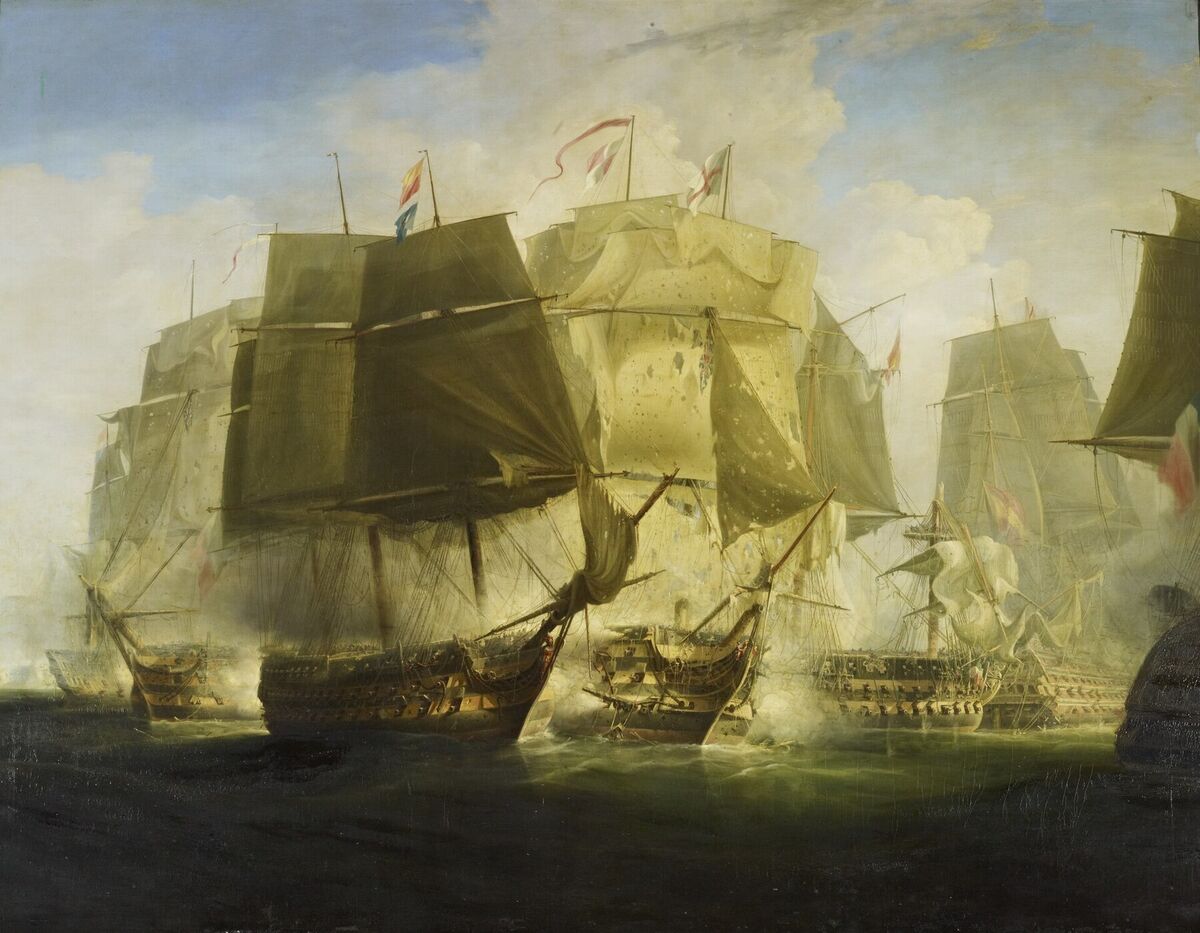
The opening shots were fired from the French ship, Fougueux at 11:3542. At this point, the column following Collingwood was considerably ahead of Victory and the weather column. Ten minutes after the first broadside, Victory came under heavy fire from five or six of Villeneuve’s ships. Double headed shot carried away the mizzen topmast, round shot peppered the fore topsail, smashing the yard, and bringing down the fore topgallant mast. The steering wheel was also hit, without loss of life. The tiller was moved by twenty men with block and tackle for the remainder of the battle. Nelson changed course for Bucentaure as soon as Villeneuve’s flag was spotted on her masts. The first broadside, fired as Victory passed under Bucentaure’s stern, tore through the decks of the flagship. Every cannon was loaded double, dismounting twenty guns and killing or wounding 325 Frenchmen. As Victory poured shot into Villeneuve’s flagship, she ran up against Redoubtable’s port side. The two ships locked in combat, exchanging musket fire and grenades. Then, at 1:15, Admiral Nelson fell, struck in the shoulder by a musket shot from Redoutable’s mizzen top. Nelson was carried below, where he soon died. Captain Jean-Jacques Lucas, commander of the Redoubtable, continued to resist, though under fire from the British ship, Temeraire. He ordered the main yard cut down to form a boarding bridge. Hoard of French seamen rushed across the yard, clashing with Victory’s marines. Finally, Redoutable surrendered, as entered in Victory’s log:
At 1.30 the Redoutable having Struck her Colours we ceased firing our Starboard Guns but continued engaging with the Sanstissima Tinidad and some of the Enemy’s Ships on the Larboard [port] Side Observed the Temeraire between the Redoubtable and another French ship of the Line both of which had Struck – the Action continued General until 3 o’clock when several of the Enemy’s Ships around had Struck- Observed the Royal Sovereign with the Loss of her Main and Mizzen Masts and several of the Enemy Ships around her dismasted At 3.30 Observed 4 Sail of the Enemy’s Van, Tack and stand along our Weather Line to Windward fired our Larboard Guns at those that would not reach At 3.40 made the Signal for out Ships to keep their Wind and engage the Enemys Van coming along our Weather Line – At 4.15 – The Spanish Rear Admiral to Windward Struck to some of our ships, which had tacked after them.43
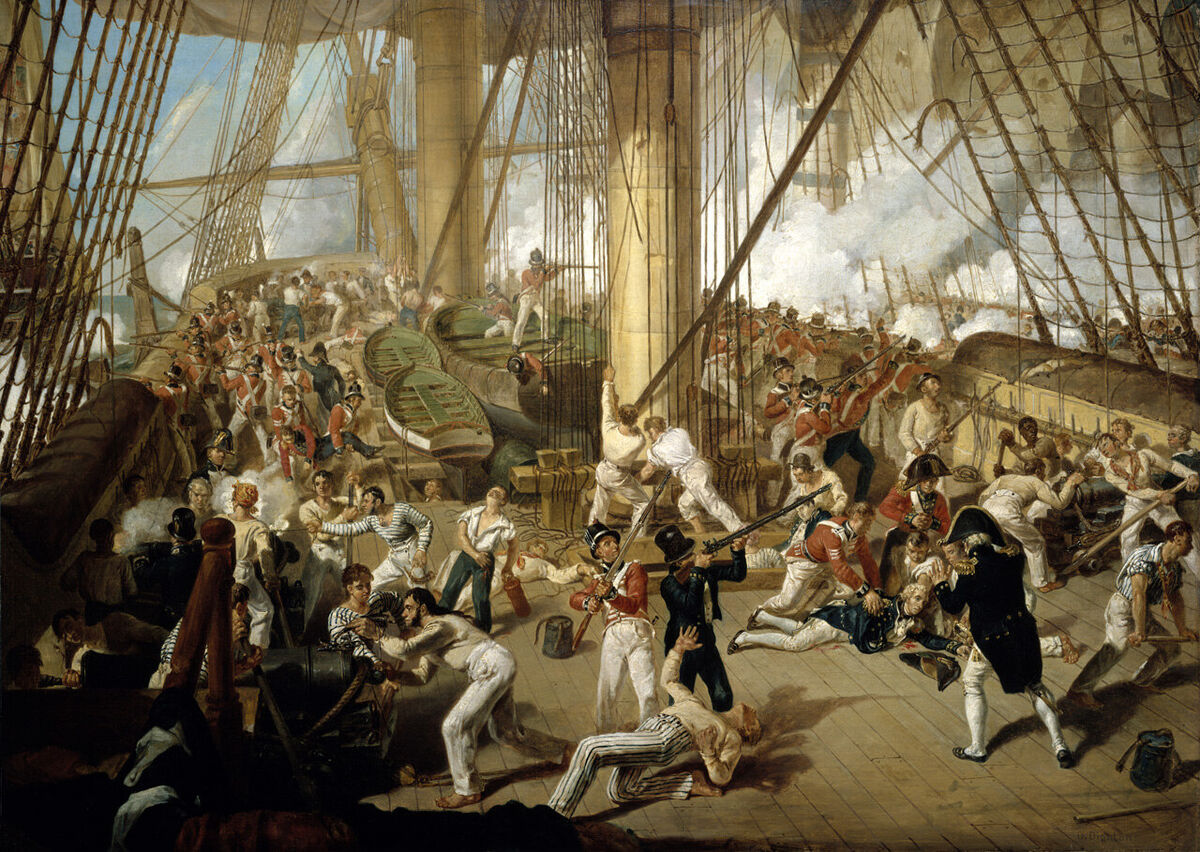
The battle over and resoundingly won, all hands worked to repair or at least jury-rig their ships and their prizes. As luck would have it, a storm began to rise as soon as the battle ended. Many of the prizes were lost, along with their British prize crews. Victory made for Gibraltar with the rest of the fleet, finally limping into harbor on October 23rd. Two weeks later, fitted with jury masts, Victory sailed for Portsmouth in the company of Belleisle and Bellerophon. Upon entering the Channel, the ship taken under tow and pressed with visitors, including Arthur Devis, painter of “The Death of Nelson”. (see Figure 10) At the Nore, inside the mouth of the Thames, Nelson’s body was transferred into the yacht Chatham. His funeral was one o the last full heraldic funerals ever staged in Britain, including a long procession on a black royal barge, a gold encrusted coffin, and a suit of knight’s armor made especially for the occasion. The funeral was more than an elaborate procession, it was a very symbolic event that marked Nelson’s transition from mortal man to immortal hero.44
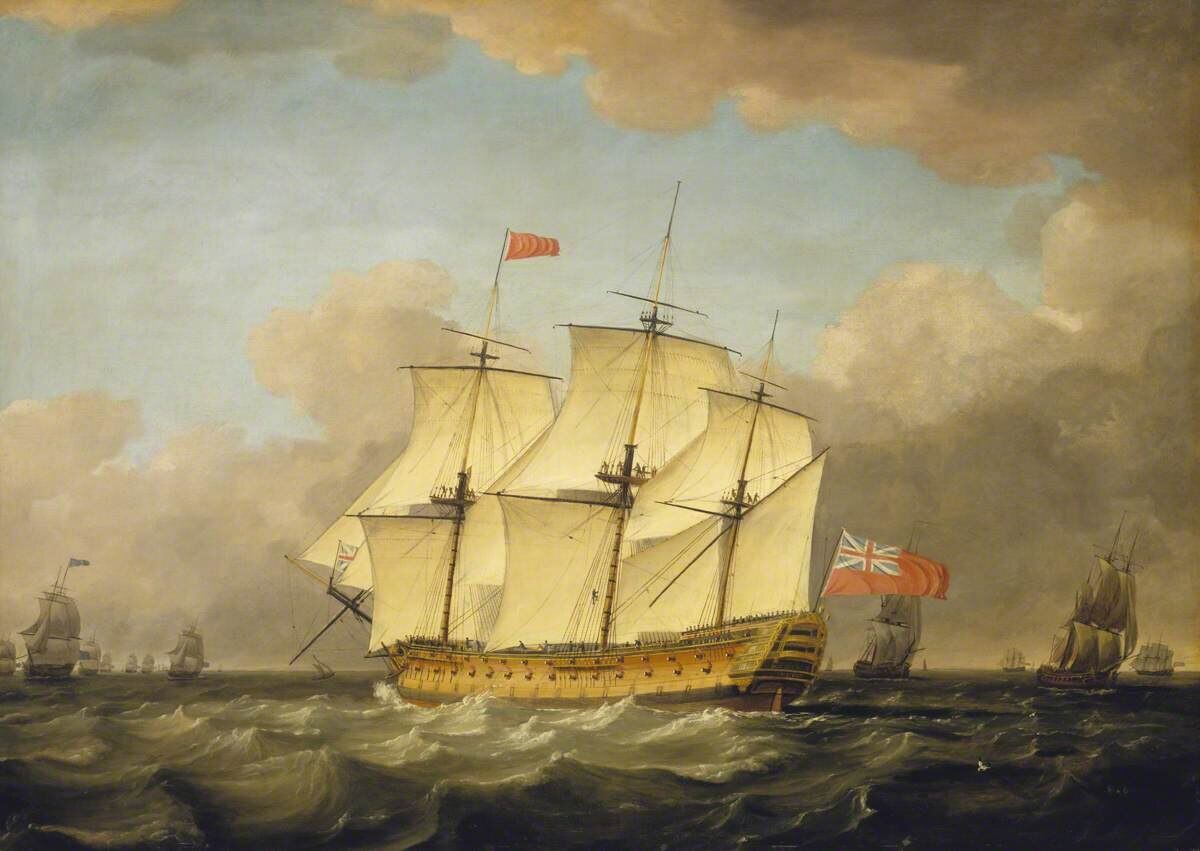
In the years after Trafalgar, Victory was refitted and reduced to a 2nd rate ship of 98 guns. Her armament was lighter to lessen the stress on her aging hull and leave more room for troops and her bows were converted to round-bows. (see Figure 11) Under the command of Captain Philip Dumaresq, Victory took part in the evacuation of Moore’s army from Vigo. As the troops were loaded, French soldiers under Marshall Soult advanced, only to be defeated by a final rearguard action. In 1809, under Vice-Admiral Sir James Saumarez, Victory sailed for Sweden to blockade the Russian fleet at Kronstadt and keep and eye on the Danes. The campaign in the Baltic lasted until 1812. Victory spent this time supporting amphibious assaults. When she returned to England, Victory underwent her largest refit, totaling 79,772 pounds. For the next twenty years she was placed in the command of various Captains but never left Portsmouth. When the order for her disposal came in 1831 Captain Hardy, Victory’s commander at Trafalgar and now the First Sea Lord, refused to sign it. Thus Victory was recommissioned as the flagship of the Port Admiral. She held similar positions until 1922, when the first restoration effort began.
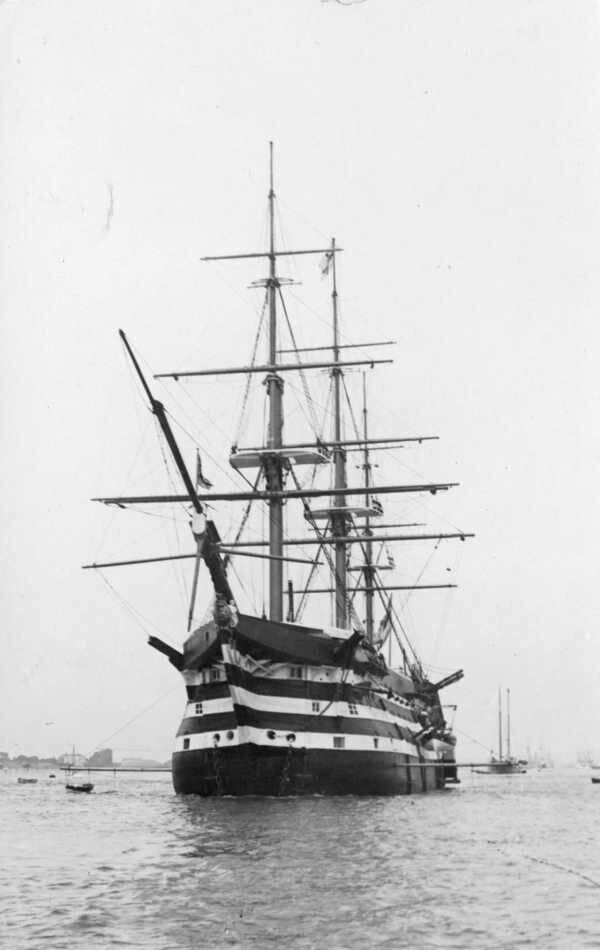
The action at Trafalgar in 1805 was certainly the highlight of Victory’s career. Admiral Nelson’s resounding defeat of the Combined Fleet frustrated Napoleon’s plans of invasion, both cross-Channel and through Egypt into India. At the close of the battle, the French and Spanish had lost twenty-one ships of the line, while the British lost none. The Spanish navy was particularly devastated; a quarter of her best vessels were destroyed and twelve of the fifteen captains, the pick of the officer corps, were dead or wounded, including four admirals. The Spanish were drawn into the conflict with Britain by Napoleonic France, and had no state interest in the war. The government was unable to suppress the news of defeat and the wreckage of all the Spanish and French warships that washed up on the Spanish coast. With a weaker navy, Spain was unable to maintain connections with the Central and South American colonies, where independence movements were quickly spawning. The naval resurgence that Spain had enjoyed was ended very effectively by her losses at Trafalgar. On the other hand, Napoleonic France was generally unfazed by the defeat. In early 1805, Napoleon had over seventy ships of the line, so the loss of thirteen was not debilitating. The careful blockading strategy that the British employed before and after 1805 served to isolate the individual squadrons in their ports. For the remainder of the war, the French were unable to organize a formidable force, but Napoleon continued to scheme for an invasion of Britain. To this end, he had a first rate built in every port that fell into his control during the war, from the Adriatic to the Baltic. By 1813 he had eighty completed and thirty-five still building. A contemporary observed, “Britain had to strain [her] efforts to the utmost to keep pace with French building; and, had the war continued, the French ... would in a short time have outnumbered up, so ... determined was Bonaparte to try and master us on our own element”.45 The outcome of Trafalgar was carefully left out but the news of Nelson’s death was spread in every newspaper, so the French people did not suffer the demoralizing impact that this news had in Spain. In late 1805, Austria joined the Third Coalition and Napoleon redirected his armies to central Europe. The invasion camp at Boulogne was slowly abandoned. Napoleon won a long string of complete victories in Germany and Austria, but the heads of state in France saw how ineffective their navy was and knew that an attack on Britain was completely unfeasible. At the same time, the crucial obstacle that stood in Napoleon’s way, the Channel, served to protect the French rear, allowing Napoleon to venture far further from home, with a much bigger army to boot.
Popular response to the victory at Trafalgar was at least as enthusiastic as the French celebration of Ulm and Austerlitz. The victory cemented an already prevalent feeling of naval superiority for the British people, one whose roots lie in the days of the Armada and Sir Francis Drake. The English were quick to realize the uses of a Navy in supporting amphibious assaults, effectively using that strategy against Napoleon in Iberia and against the Americans in 1812. At the same time, the British had a great, victorious Admiral to mourn. His heroic qualities and the timing of his victory made him into a savior for the British people, especially their navy. In the next 150 years, naval leaders asked themselves ‘What would Nelson have done?’, and this legacy bound them together. Even when Dreadnoughts replaced sailing ships, the tactics of Trafalgar remained a very serious study for British naval officers because they aspired to that level of destruction, indeed, the victory at Trafalgar gave Britain a command of the sea that was not challenged until World War 1.
Since the battle of Trafalgar was also the last great engagement involving sailing-ships, the ships involved in that battle are noteworthy and indeed, the greatest of those ships, Victory, has become an icon just like the Admiral she carried on that famous day. Her design represents the pinnacle of sail-powered naval warfare because very quickly afterward the growing scarcity of oak made such large and complex warships unfeasible. The shipbuilding methods of this era have long since been replaced by the welding iron, but the simplicity of eighteenth century maritime technology is perhaps one of the more interesting details of Victory’s construction and career. She and hundreds of others just like her were made entirely by hand, with an adz and a chisel from wood, flax, and hemp. The complexity and beauty of these ships has fascinated the nautically inclined for some centuries now, and will continue so long as man is drawn toward sea, where the wind meets the waves.
Bibliography
Anderson, Romola, and R. C. Anderson: The Sailing Ship. New York: W. W. Norton & Co., 1963.
Cahill, Richard A., “The Significance of Aboukir Bay,” U.S. Naval Institute Proceedings, 93(7): p. 79.
Callender, Geoffrey, Sir: The Story of the H.M.S. Victory. London: P. Allan, 1929.
Hoffman, Frank G, “A littoral Leader,” U.S. Naval Institute Proceedings, 122(10): p. 60.
Lambert, Andrew, “Nelson, Trafalgar and the Meaning of Victory,” History Today, 54(11): p. 52.
Naish, George P. B.: H. M. S. Victory. London: Pitkin, 1972.
Warner, Oliver, “H. M. S. Victory,” History Today, 15:5: p. 306.
Warner, Oliver: Victory, the Life of Lord Nelson. Boston: Brown Little, 1958.
Wharton, W. J. L: A Short History of the H. M. S. Victory, Gathered from Various Sources. Portsmouth: Griffin, 1884.
Whipple, A.B.C.: Tall Ships and Great Captains. New York: Harper & Brothers, 1951.
Romola & R.C. Anderson, The Sailing-Ship (New York: W. W. Norton & Co., 1963), 117↩︎
R & R.C. Anderson, The Sailing Ship, 118↩︎
R & R.C. Anderson, The Sailing Ship, 119↩︎
R & R.C. Anderson, The Sailing Ship, 123↩︎
R & R.C. Anderson, The Sailing Ship, 131↩︎
R & R.C. Anderson, The Sailing Ship, 132↩︎
Geoffrey Callender, The Story of the H.M.S Victory (London: P. Allan, 1929), 75↩︎
R & R.C. Anderson, The Sailing Ship, 141↩︎
A.P. McGowan, The Century Before Steam: the development of the Sailing Ship 1700-1820 (London: Her Majesty’s Sationery Office, 1980), 16↩︎
G. Callender, The Story, 29↩︎
A.G.E. Jones “Sir Thomas Slade,” The Mariner’s Mirror 63(3) (February 1977), 2↩︎
A. Jones “Sir Thomas Slade,” 3↩︎
Peter Goodwin, The Ships of Trafalgar (Annapolis: Naval Institute Press, 2005), 22↩︎
G. Callender, The Story, 30↩︎
John McKay, The 100-gun ship Victory (Annapolis: Naval Institute Press, 2000), 8↩︎
J. McKay, The 100-gun ship, 10↩︎
J. McKay, The 100-gun ship, 15↩︎
J. McKay, The 100-gun ship, 16↩︎
J. McKay, The 100-gun ship, 21↩︎
P. Goodwin, The Ships, 22↩︎
G. Callender, The Story, 33↩︎
G.P.B. Naish, H.M.S. Victory (London: Pitkin, 1972) , 4↩︎
G. Callender, The Story, 42↩︎
A.P. McGowan, HMS Victory; her construction, career, and restoration (Annapolis: Naval Institute Press, 1999), 213↩︎
G. Callender, The Story, 49↩︎
P. Goodwin, The Ships, 22↩︎
G. Callender, The Story, 55↩︎
G. Callender, The Story, 55↩︎
G. Callender, The Story, 57↩︎
G. Callender, The Story, 60↩︎
G. Callender, The Story, 67↩︎
A.P. McGowan, HMS Victory, 16↩︎
P. Goodwin, The Ships, 23↩︎
P. Goodwin, The Ships, 24↩︎
P. Goodwin, The Ships, 24↩︎
P. Goodwin, The Ships, 25↩︎
P. Goodwin, The Ships, 25↩︎
P. Goodwin, The Ships, 27↩︎
Robert Gardiner, The Campaign of Trafalgar, 1803-1805 (London: Chatham, 1997), 133↩︎
R. Gardiner, The Campaign, 132↩︎
R. Gardiner, The Campaign, 146↩︎
Mark Adkin, The Trafalgar Companion, (London: Aurum, 2005), 483↩︎
P. Goodwin, The Ships, 29↩︎
R. Gardiner, The Campaign, 183↩︎
R. Gardiner, The Campaign, 184↩︎