Full text
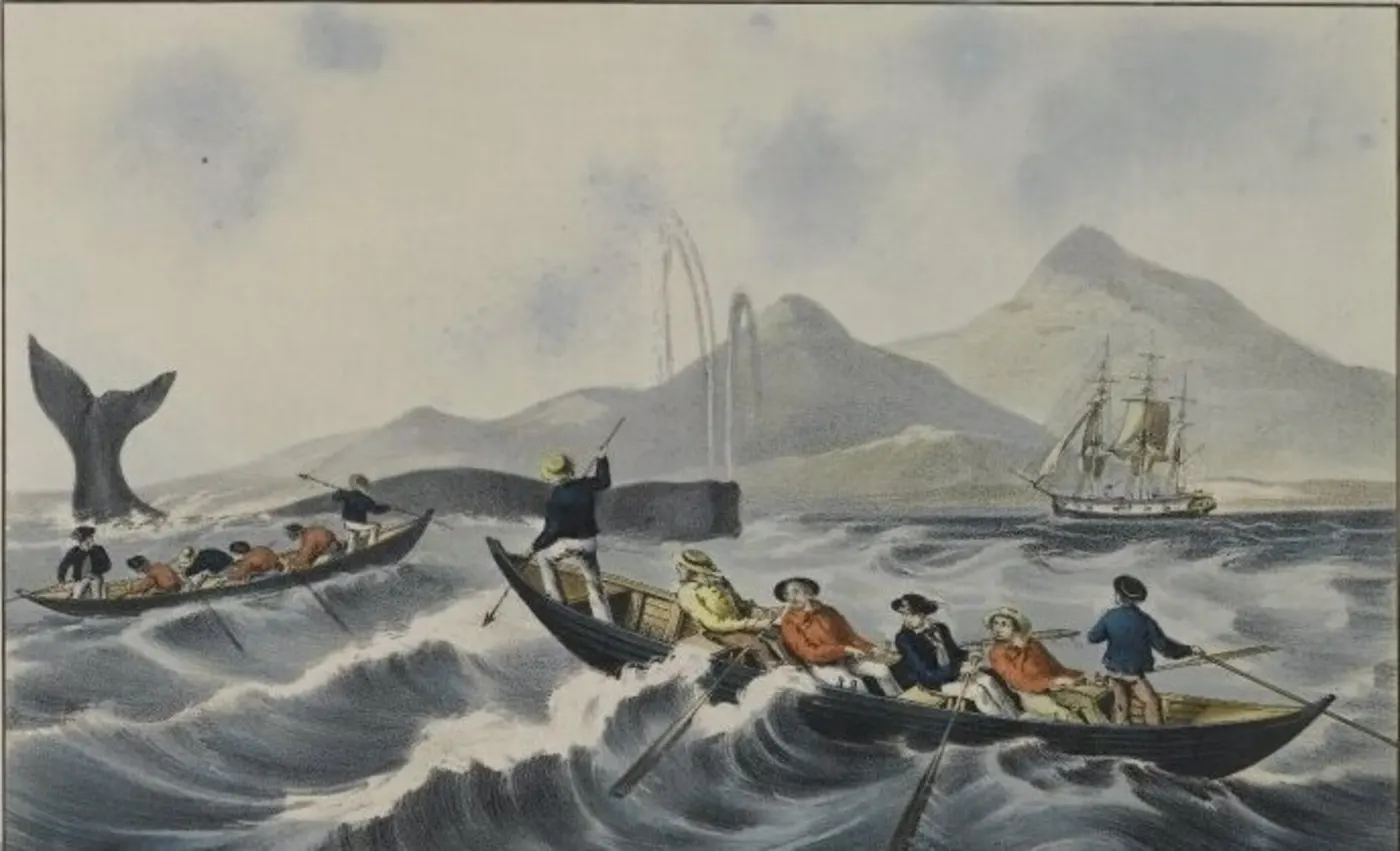
The nineteenth century was the heyday of New England’s whalers, but the origins of their fishery are in many ways more interesting. These can be traced back to the Basque Whalers in Labrador of the sixteenth century. In the British colonies, the first whaling operations were on the eastern end of Long Island around 1660 and involved six men in a skiff1. Some fifty years later, the Royal government in New York had extended its political control into Long Island. The whalers of Long Island did not take kindly to the taxes that New York imposed on their fishery. Men like Samuel Mulford, who owed their allegiance to Connecticut, protested New York’s involvement in Long Island’s economy in written pieces that have survived. Mulford’s piece, published in 1716, reveals that whaling was conducted on a very small scale and at considerable risk for the participants, so that the taxes imposed by New York constituted a significant threat to the fishermen’s livelihoods.
Another fifty years later, the whale fishery has developed into a large-scale industry. In 1764 the House of Representatives in Boston published a bill entitled “An Act for Regulating the Whale Fishery.” In the introduction to the document, the legislators make it clear that they intend to protect investors and captains from errant seamen. They motivate their regulations by noting that “the welfare of this Province in a great measure depends on the Whale Fishery … and whereas for several years past the said Whale Fishery has been exposed to great Difficulties and Expenses … all which is a great discouragement to the Whale Fishery.”2 In the details of this bill and in a contract drawn up for a whaling voyage, the growth of the whaling industry in the fifty years since Mulford’s protest is evident. Its frailty is also emphasized, and it is apparent that the governments involved in the whale-fishery have become more concerned with its prosperity.
Studying the development of that fishery in the years immediately before and after the American Revolution gives us a nominalist perspective on the impact that the economic struggle between Britain and the United States had on the American industries that produced for the British market. The whale fishery was “as unprofitable to the adventurer, as important to the public.”3 Because of this fragile nature, the effect of Britain’s hostile trade policies is dramatic. One of the more interesting episodes of the narrative provided by this set of documents is the attempt made by both Britain and France to lure the whalers of New England to Europe. This international struggle over the New England whale-fishery was eventually resolved when France removed all taxes on whale oil imports from America, allowing New Englanders to pursue their whaling in America. However, the lengths to which France, and especially Britain, were willing to go to absorb the American whalers into their economies reveal the importance of this fishery.
The fragile nature of New England’s whaling industry and the obstacles that New England governments put in the way of its success emerges from the individual examples Samuel Mulford provides in his protest of New York’s taxes. Along with his own case, he presents the cases of Richard Floyd and that of his son. Mulford describes at great length the trouble and cost that his repeated journeys to New York City have caused him. Most of this section is obscured, but it describes at least four journeys of over one hundred miles each. He was forced to travel great distances at his own expense to defend himself, and various formalities and fees forced him to make that journey several times. In one episode, he was summoned back to New York upon returning home to East Hampton because he hadn’t paid the twenty-shilling discharge fee, so that Mulford was compelled to “ride 130 miles to pay them twenty shillings, I being near seventy years old.”4
Later in his piece, Mulford describes Richard Floyd’s case as follows. Captain Howl’s company killed a whale and brought it on shore. They had a license from the Governor that forfeited a twentieth part of the catch to New York. During the night the whale was blown forty miles down the beach, washing up on Richard Floyd’s property. Captain Howl commissioned Floyd to cut the whale apart and make it into oil. Richard Floyd was then prosecuted by New York for failing to pay taxes on the whale. He is required, along with the eight men of Captain Howl’s company, to travel to New York (one hundred miles) in the following summer to pay the twentieth part of the whale they caught and processed the previous winter. Because the fishermen refused to pay the tax, the Governor would not issue their licenses for the following year, so that any whaling would meet with more molestation and charges.5
Finally, Mulford describes the persecution of his son, Mathew Mulford, who was tried with his father on the same charges. Mulford laments that his son “then had not on Foot of Land”6, so that Mulford had to bear the burden of the charges and the traveling expenses for the journey required. His position in the Assembly of East Hampton made it possible to send a courier to New York to answer the charges in his stead. However, the Receiver General would not accept the money, forcing Mulford to make the journey himself. When Mulford appeared in New York, the authorities frustrated his attempt to settle the debt. The Receiver General sent him to the Attorney General, who refused to accept the payment and directed Mulford to the Court of Chancery. The decree of the court was that Mulford should pay the Receiver General, but if they did not accept payment because of additional charges, then the Master of the Chancery should collect the fee. Mulford paid the Master of the Chancery and returned home. Upon his return, the sheriff arrested him on charges of contempt because he had not followed proper discharge procedures, which included the twenty-shilling fee already mentioned.7
Samuel Mulford’s piece provides individual cases that show the government of New York pursuing policies that hindered the whale fishery. They imposed taxes on the whale catch that were previously unheard of. “The captors [had not] heard of and duty for so doing, until of late … when generally it was look’d upon to be an imposition, contrary to the law of the colony.”8 The taxes imposed by New York were more than a financial burden. The authorities who collected the tax had their office in New York, forcing the whalers to make at least one trip every year to purchase the whaling permit, and if charged for withholding taxes, they might make many more, as Mulford’s example demonstrates. The exploitative nature of New York’s attitude toward the whale-fishery soon changed as governments realized the importance of the whale-fishery.
In 1764 an attempt at regulating the whale fishery was made by Massachusetts. The bill, “An Act for Regulating the Whale Fishery”, was published by the Massachusetts General Court “for the consideration of the several Towns in this Province.”9 The changes in the colonial governments’ attitude toward the industry emerge from the introduction of the bill. After acknowledging the vitality of the whale-fishery for the welfare of the province, the bill addresses the labor problems that have troubled the industry and endangered its investors. The principle point of the bill is that articles of agreement about the duration of the expedition and the shares of the profit must be drawn up in the presence of the entire crew and signed before the ship leaves the dock.10
In the individual points of the bill, the details of a whaling expedition are addressed in turn laying out a system of regulations for hiring and paying the crew of a whaling ship, all enforced by fines. A crewmember must join the agreement within three days of joining the expedition and if that crewmember leaves the ship before the end of the voyage, he must pay the owner a fine of ten pounds and forfeit his wages for the rest of the trip. Vessels are required to have adequate provisions for the voyage, and if a member of the crew is not given provisions, then he is entitled to prosecute for a maximum sum of forty shillings. When the ship returns from a voyage, the captain has fifteen days to pay the crew their share of the profits. Altogether they protect the interests of all those involved in the fishery and underscore the governments’ growing concern with fostering the growth of the whaling industry.11
In “Articles of Agreement relative to the Whale-Fishery” the regulations outlined in the Bill of 1764 are obeyed, and a list of provisions is provided. These provisions include 75 pounds of fat, 50 pounds of butter, and 56 pounds of sugar. The Articles also outline the division of profits. One quarter each will go to toward the vessel and the supplies and one half to the captain and crew. At the bottom of the document the members of the crew bind themselves to the agreement and accept a penal sum of 200 pounds for any infractions.12 The formal language and the strict adherence to the regulations of the 1764 bill demonstrate that the whale-fishery has grown from the fledgling fishery of Mulford’s day into one that is conducted on an industrial scale. This growth is also demonstrated by the list of provisions detailed by the agreement.
The growing importance of the whale-fishery is evident in a document published by the Secretary of State (Thomas Jefferson) in 1791. It addresses developments in the whaling industry after the American Revolution. On the eve of the revolution, New England had more than 300 ships in their whaling fleet, far more than England or France.13 During the war the fishery halted, and after, because the United States separated from Britain, New England’s whalers lost their primary market and their fishery dwindled. Eager to absorb America’s whaling industry, England offered lucrative deals to New England whalers to encourage them to base their operations in Great Britain. France, ever wary of her rival, offered similar bounties. Thomas Jefferson’s report pushes measures intended to rejuvenate Americas’ fishery and protect it from international competition. His key point is that additional markets must be found for whale oil so that investors and captains can be certain of a profit. He also suggests a “retaliating duty” to limit international competition and the “remission of duties on the articles used for their calling.” 14 The United States, searching for other markets, turned to France, who, having “aided in detaching the U.S. from the force of Great Britain … seemed to have indulged only a silent wish to detach them from her commerce.”15 A proposal was sent to the French, demonstrating that one third of Americas exports might go to France in exchange for manufactured goods if restrictions and duties were lifted. Motivated by English attempts to absorb America’s whale-fishery, France agreed.16
The international struggle over New England’s whale-fishery demonstrates how much its importance grew in the seventy-five years since Samuel Mulford’s protest. Interestingly, the economic frailty of the fishery is emphasized in all of the documents, especially toward the end of the period. In Jefferson’s “Observations” he describes the fishery like this:
“The whale fishery is the poorest business into which a merchant or sailor can enter. It is attended with great risk, singular hardships, and long absences from his family … [the merchant] finds it does not reimburse him his expenses … for example, an English ship of 300 ton and 42 hands brings home, after a four month voyage, 25 ton of oil, worth 437l. 10s, but the wages are 400l., leaving 37l. for the outfit and the merchant.”17
Why would governments spend so much money supporting this unprofitable fishery? The military interests are one possible explanation. Indeed, Jefferson tells us that France opened her ports to American oil to prevent the transfer of five thousand of the best seamen to the marine strength of her enemy.18
The base of Jefferson’s argument is New England whalers’ inability to compete with the government-sponsored fisheries of England, France and Holland. Of the three, the government of England was the most eager to foster her whaling industry. During the revolutionary war, when New England’s whalers did not operate, Great Britain “seized the opportunity of pushing hers.”19 The ship that brought in the most oil in a year received 500 pounds; the second received 400, and so on until the fifth, which received 100 pounds. Also, England offered other bounties for the recently discovered southern fishery, where the sperm whale was found. The Dutch government aided their fishery with similar, if smaller, bounties. The States General of Holland paid men of their fishery thirty guilders per year.20 The incentives offered by the French government were aimed at countering the British bounties and attracting whalers to France, but were less successful: the British fleet grew from less than 100 before the American Revolution to 314 in 178821 while the French fleet had only fourteen ships in that same year. No longer within the British economic sphere, American whale oil was subject to the foreign duty when going to the English markets that more than equaled the value of the oil and served as an effective trade ban.22 The government incentives that European whalers enjoyed enabled them to undersell New England’s whalers in the other European markets because Americans were only aided, in Jefferson’s words, by “poverty and rigorous economy.”23
This increasingly unfair competition was part of a coercive effort made by England to absorb the whaling industry of New. As part of their expansion into the southern, sperm whale fishery, England extended an offer to New Englanders that would label them as ‘foreigners who had been employed in the whale-fishery’ so that, if they moved to a British territory in America or Europe, they would be exempt from the British foreign duty.24 Many whalers, left without a market for their goods, considered moving their operations to Nova Scotia while others, motivated by greater bounties, thought of moving to England.25 The French government offered fifty livres per ton for vessels that whaling outfits brought to France. Only nine families accepted the offer, leading the French to adopt a different strategy. In December 1787 taxes and duties were removed from whale oil imports so that New England would have a market for their product and so that its whalers could pursue their fishery from home. Whalers operating out of England immediately flooded the French market with their oil. They were able to undersell the Americans and the native French because of the aid their fisheries received from their government. In response, the French closed their ports to all foreign whale oil in the arret of 1788.
Thomas Jefferson, serving then as the American Minister in Paris,26 published his response to these developments in his “Observations on the Whale-Fishery.” He uses detailed accounts of the French whale-oil market and the production of her domestic fishery to deduce that France has enough whale oil for one year of ordinary consumption.27 He argues that France will again look for oil to import, but will be forced to turn to England because the American fishery, “crushed by the arret of Sept 1788 … in its effort to revive, will rise no more.”28 Jefferson then calls for France to open her ports to the United States to help “maintain the field against the common adversary,”29 and indeed, by the arret of December 1788 the ports of France were open to American whale-fishers while remaining closed to all Europeans.
The great lengths to which England went to dominate the fishery, France’s intervention, and the establishment of trade relations between France and the United States are only one part of the economic re-organization that occurred in the North Atlantic after the American Revolution. This narrative explores the whale-fishery’s development into a large, government supported industry and provides a better understanding of the effects that the economic instability had on American industries that produced for the British market. The unprofitable nature of the fishery and the willingness of European governments to devote large sums of money to subsidize their fleets is perhaps the most interesting point that rises from the documents. Perhaps, as already mentioned, the military value of whale-ships and their crew prompted this policy. Looking at government documents from the period would provide some clues.
Works Cited
Articles of Agreement Relative to the Whale-Fishery. Boston, 1769.
Jefferson, Thomas. Observations on the Whale-Fishery. New York, 1778.
Massachusetts General Court. A Bill, Now Pending … Intituled, An Act for Regulating the Whale Fishery. Boston, 1764.
Mulford, Samuel. An Information … Defence of his Whale Fishing. New York, 1716.
Report of the Secretary of State, on the Subject of the Cod and Whale Fisheries. Philadelphia: John Penno, 1791.
“Thomas Jefferson: First Secretary of State, 1790-1793.” US Department of State Database. 2005. http://www.state.gov/r/pa/ho/time/nr/14317.htm.
Samuel Mulford, An Information … In Defence of his Whale Fishing (New York: 1716) p 1↩︎
Massachusetts General Court, A Bill, now Pending … Intituled, An Act for Regulating the Whale Fishery (Boston: 1764) p 1↩︎
Report of the Secretary of State, on the Subject of the Cod and Whale Fisheries (Philadelphia: John Penno, 1791) p 3.↩︎
Mulford, p 3↩︎
Mulford, p 2-3↩︎
Mulford, p 3↩︎
Mulford, p 3↩︎
Mulford, p 1↩︎
A Bill…, p 1↩︎
A Bill…, p 1↩︎
A Bill…, p 2-3↩︎
Articles of Agreement Relative to the Whale-Fishery (Boston, 1769) p 1↩︎
Thomas Jefferson, Observations on the Whale-Fishery (New York, 1778) p 3↩︎
Report…, p 12↩︎
Jefferson, p 6↩︎
Jefferson, p 6↩︎
Jefferson, p 3↩︎
Jefferson, p 5↩︎
Report…, p 9↩︎
Report…, p 11↩︎
Jefferson, p 9-10↩︎
Report…, p 9↩︎
Report…, p 11↩︎
Report…, p 9↩︎
Jefferson, p 3-4↩︎
“Thomas Jefferson: First Secretary of State, 1790-1793.” US Department of State Database. <http://www.state.gov/r/pa/ho/time/nr/14317.htm>↩︎
Jefferson, p 10↩︎
Jefferson, p 10↩︎
Jefferson, p 12↩︎