Full text
Much like the rest of the Russian state, the Russian Navy was a hopelessly backward one at the turn of the twentieth century. A very clear illustration of this fact is the navy’s complete destruction at the hands of the Japanese at Tsushima. One of the more remarkable navy men of that era, Admiral Stepan O. Makarov, played a small but valiant role in that war. He also published a series of works that revised Russian naval tactics and outlined the general backwardness of the Russian Navy, both of which were generally ignored by the tsarist leadership. Many years later, after World War Two, Sergei Gorshkov rose in the ranks. He was a similarly impressive navy man who also published a variety of works on naval tactics that were better received by the top leaders, advancing him to the navy’s highest rank. In this role he put together a world-class navy for the Soviet Union. It is interesting to compare the careers of these two men and to try and understand why Makarov was unable to gain support from the Tsarist government for his reforms while Gorshkov was allowed to engineer a new navy for the Soviet Union.
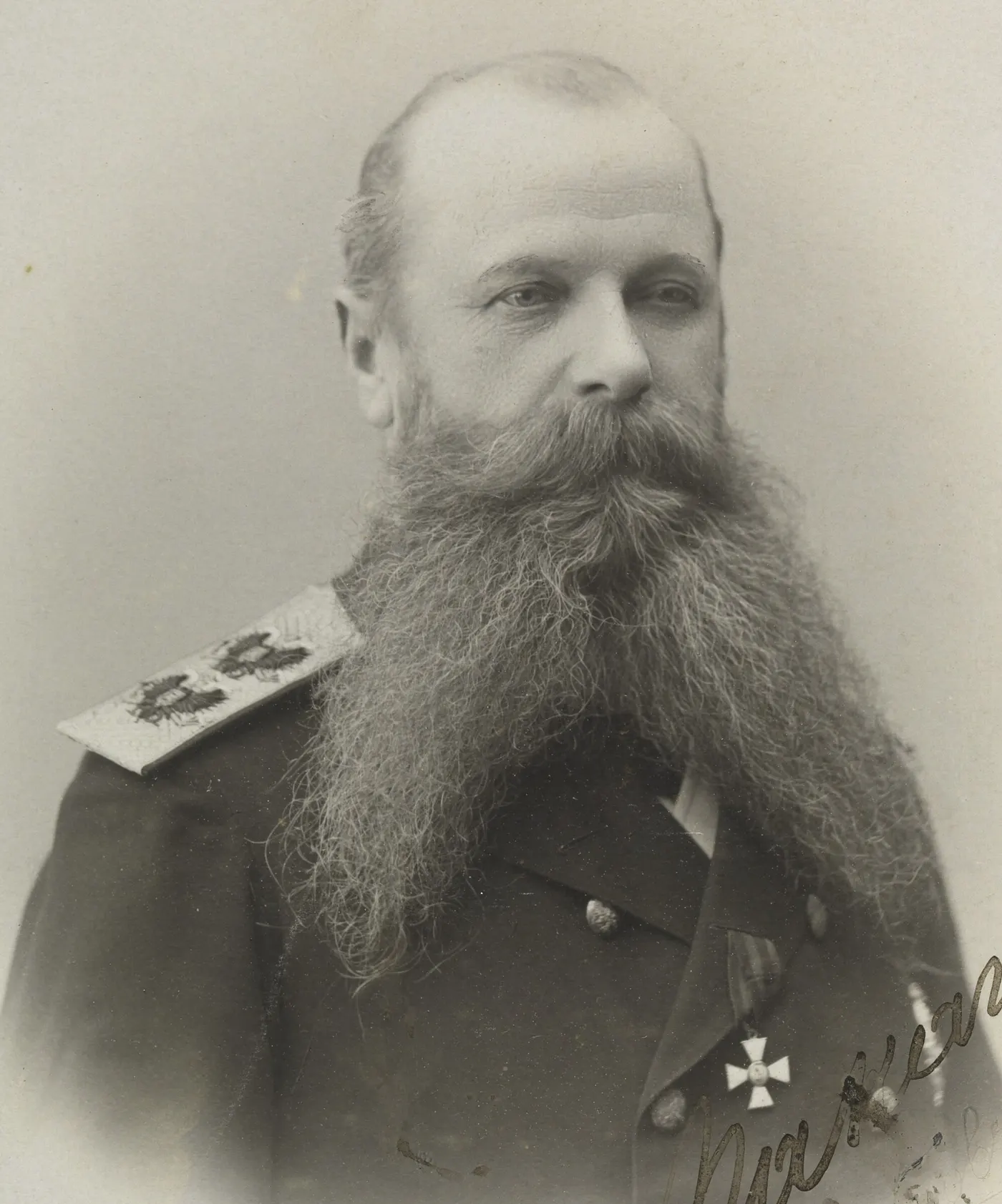
Makarov was one of Russia’s greatest naval officers. His praises include, “inseparably linked with the history of the development of the Russian fleet”, “a recognized authority in the sphere of naval tactics”, “[Russia’s navy’s] most talented representative in the late 1800s and early 1900s” and perhaps most impressively, “Makarov was one of the most talented and eminent sailors of his day, and, in the eyes of many of his contemporaries, a naval theorist who ranked with Philip H. Colomb and Alfred T. Mahan.”1 Sending this extremely capable man to the besieged Port Arthur may be one of the only things the Russian government did correctly in the course of the Russo-Japanese war, though they did so a few years too late.
Admiral Makarov grew up and attended naval school in the Siberian port of Nikolaevsk-na-Amure. He finished his training in the Baltic Fleet and started what would become a long list of naval inventions by improving the survivability of warships. In the war against Turkey, Makarov commanded a steamer that he converted to tow torpedo launches. His successful torpedo campaign drew a lot of attention to him, earning him national fame, numerous decorations, and a promotion. The next 25 years were spent making remarkable advances in all types of naval service, including diplomacy, Arctic exploration, ship design, oceanography, and finally, a lot of professional writing. He voiced opposition to Russia’s naval policy on several occasions. Makarov stressed that the fleet should be ready for war, that the crews should be thoroughly trained and that war plans should be drawn up. He also exposed the insufficiencies of Port Arthur and Vladivostok as naval bases and requested uniformity in ship types, long-range reconnaissance, improved artillery, armor plate, and naval communications. None of his recommendations were headed, though he was later proved to be right on every count.
Makarov made important contributions to naval theory that further illustrate the backwardness of the Russian Navy. To understand these contributions and the point that will be illustrated, some background is required. During Makarov’s lifetime, naval technologies advanced considerably. These advancements provoked a lively debate aimed at fleshing out a set of tactics to govern modern naval warfare. The works of the Philip H. Colomb (British) and Alfred T. Mahan (American) published in 1890, stimulated this debate. These works dissected the great naval battles of the past, looking for general guidelines by which victory could be assured. Their works were very successful: translated into various foreign languages and accepted by naval men throughout the world. It is important to note that the Russian translation, commissioned by Commander in Chief of the Imperial Fleet, was carried out in 1895.2 The works were embraced in the Russian Navy because, “a commitment to imperial expansion based on a Mahanian doctrine of sea power obviously seemed to offer many Russian sailors the chance finally to take their rightful place alongside the soldiers as equals in defense of the interests of the Fatherland.”3 This broad acceptance of Mahan and Colomb’s pieces led the Russian Admiralty to ostracize the tactical work of Makarov, which undermined those works.
Makarov devoted much of his life to naval tactics, writing on the topic as early as 1885. In 1893, Makarov noted to the Russian Admiralty that Russia lacked a guide to naval tactics. He recommended a series of training courses in other fields that would provide a comprehensive set of tactical principles. During his 1894 deployment to the Pacific after the Sino-Japanese war, it was noticed that there was no standard tactical guide to govern the actions of the Russian fleet. Makarov was ordered to fill the gap with a provisional guide. When the crisis subsided, he returned to St Petersburg determined to provide Russia with a modern tactical handbook. He gave a series of lectures based on his provisional guide to an officers’ assembly in 1896. These lectures were published as articles in the Russian Naval Journal. The articles were translated into English, Italian, Spanish, Japanese, and Turkish and became standard reading for naval men around the world. An American newspaper noted Makarov’s contribution to the U.S. Navy’s victory in the Spanish-American War. His works had a less enthusiastic reception at home.
Makarov’s work was rejected in Russia because it countered the ideology of Mahan and Colomb.4 Makarov questioned the usefulness of studying historical battles—the age of sail—to develop a strategic guide for steam ships. Such a study is the basis of Mahan and Colomb’s work. Instead of accepting past practice as a guide, he maintained that a modern admiral should study the technologies and weapons available to him and the best means of using them. Based on these studies, commanders could equip ships and train crew to best accomplish their strategic goal. Makarov used this strikingly sensible reasoning to flesh out a set of modern tactics. He gave torpedoes, mines, and other developing strategies a high assessment and encouraged cooperation with other branches of the military. Makarov’s colleagues in the Russian Admiralty were only recently exposed and converted to Colomb and Mahan and embraced their ideas because they seemed to encourage expansion of the fleet.5 Makarov’s endorsement of newer technologies led these men to assume that he would not be so keen on constructing the expensive battleships that they wanted to command.6 Makarov replied to his critics with an articulate defense, published in 1897, in which he provides a concise summary of his theories and questions many of the points advanced by Mahan and Colomb. Despite an ardent defense of his excellent and timely suggestions — ones that were acknowledged around the globe — the Russian admiralty did not take heed and the Russian Navy remained in a laughably decrepit state.
Sergei Gorshkov was born on February 26 1910 and grew up as Lenin spread Bolshevism throughout Russia. He joined the Russian Navy when he was seventeen. In the years after the October Revolution and the civil war that followed it, the Soviet Navy was a weak, coastal force.7 This state grew out of both practical reality and ideological doctrine. Only 15 years earlier the Tsarist Navy had been destroyed at Tsushima by the Japanese and, in the turmoil of the revolutions, little was done to rebuild, although flotillas of river craft played a role in the civil war. Also, with the very recent Bolshevik revolution came an adherence to Marxist-Leninist ideology. As a result the ideas of Mahan and Colomb were no longer accepted because they expounded large oceanic navies which were imperialistic and instruments of capitalist states and therefore evil. In 1931, Gorshkov graduated from naval school. He was assigned to the Frunze, a destroyer in the Black Sea Fleet. He was soon transferred to the brand-new Pacific Fleet, under the command of Admiral Kusnetsov, who remembers Gorshkov as a commander of a small surface ship in his memoirs.8 He must have completed some classes at a school for captains of destroyers, because by 1938 he had command of a destroyer brigade. Obviously, he survived the military purges of 1937 and 1938, though his name was mentioned to Stalin when a new destroyer was lost in a storm. Stalin asked, “What sort of a man is Gorshkov?”9 and apparently a fellow officer defended him, because no punitive action was taken. After transferring back to the Black Sea in 1939 and commanding another fleet of destroyers, he went back to school for senior officer training at the Voroshilov Naval Academy in 1940. When the Germans invaded a year later, he was commander of cruiser brigade in the Black Sea.
Gorshkov’s role in the Second World War involved the defense of key ports in the Black Sea. In the first three months of the war, the Black Sea Fleet was occupied with the defense of Odessa. After it was cut off from the Red Army, Stalin ordered Admiral Zhukov, commander of the Fleet: “Do not abandon Odessa, defend if to the utmost, use the Black Sea Fleet to this end.”10 In the defense of Odessa, Captain First Rank Gorshkov11 organized an amphibious landing force in Sevastopol. On September 21 1941, his units steamed to Odessa aboard two cruisers and two destroyers. They landed near Odessa and secured the city against heavy opposition. The situation in Sevastopol worsened quickly in the next two weeks, and eventually Gorshkov and the fleet were pulled out of Odessa to help defend it.
After his successful operations in Odessa, Captain Gorshkov was promoted to rear admiral with command of the Azov flotilla. He was involved in the defense of Sevastopol during its eight-month siege by strong German forces. His Azov forces participated in the Kerch landing in December, the largest land-sea soviet operation of the war.12 Though initially successful, the landing force was eventually driven back across the Kerch Strait. The Red army was soon forced to abandon the city, retreating to the Caucasus. Gorshkov protected the maritime flanks of the Red army and harassed the rear of the German force during the retreat. In the summer of 1942, the Black Sea Fleet was holed up in various small ports in the east coast of the Black Sea. Gorshkov joined the Military Council of the Novorossiysk Defense District, a group of army and navy leaders whose goal was to defend the Baku oilfields. However, by September, Novorossiysk was in German hands. Soviet forces were able to hold the Germans there because the harbor was still within Soviet artillery range and therefore useless for the Germans. Various amphibious assaults were launched by Gorshkov to take back the port, but all were unsuccessful until the Battle of Kursk drew most German forces back to the main front. In September of 1943, Gorshkov’s forces managed drive the rest of the Germans out. During the next year, Gorshkov was involved with many more amphibious landings along the Russian coast in the Crimea and on the Taman peninsula. He harassed retreating Germans in the Sevastopol area and went on to assume command of the Danube Flotilla in 1944. He steamed up the river and helped liberate Ukraine, Romania, Bulgaria, and Hungary.13
In his published pieces after the war, Gorshkov reviews the performance of the Soviet Navy favorably, saying it had, “Great strike power and high mobility to achieve important results in a short time to significantly change the strategic situation in individual theaters of military operations … our state – a great continental and maritime worlds power – at all stages in its history has needed a powerful fleet as an essential constituent of the armed forces.”14
Early in his career, Stalin’s purges probably cleared a path for quick advancement for Gorshkov.15 After the war, tensions between top Soviet leaders allowed him to advance to the top position in the naval forces. Between the end of the war and 1948, Gorshkov commanded a squadron of ships in the Black Sea. In 1951, he became commander of the Black Sea Fleet and Admiral Kuznetsov was reappointed Commander-in-Chief of the Soviet Navy. Soon after, Gorshkov was moved to Moscow to become First Deputy Chief of the Soviet Navy.16 In Moscow, tensions between Khrushchev and Admiral Kuznetsov were rising. The two differed in opinion on the role that the Soviet navy should take. Khrushchev called for an emphasis on submarines over large surface ships, while Kuznetsov was a big supporter of a large surface navy. Indeed, the head of the Navy had, “at one point convinced Stalin of the need for aircraft carriers.”17 There is some speculation that Khrushchev brought Gorshkov to Moscow as a possible replacement for Kuznetsov. Gorshkov was also a good friend of Kuznetsov, having served together in various fleets, and Kuznetsov might have brought his old friend to Moscow to be his deputy. Either way, Gorshkov became head of the Soviet Navy in June 1956. The rest of the high-ranking officials accepted him; by this time many of the officers he had served with on the southern front had advanced to influential positions.
Only after he reached the top rank in the navy did Gorshkov’s views on the role of the navy start appearing in various publications and speeches. For the rest of the fifties and early sixties he followed party line and supported a vision of a navy that would defend the Soviet Union’s maritime borders. In 1962, Khrushchev visited a Leningrad shipyard and was pleased with the development of the navy and later that year Gorshkov was promoted to fleet admiral.18 Perhaps confident in being on Khrushchev’s good graces, Gorshkov began to expound the importance of large surface ships in a modern navy. He managed to convince Khrushchev to abandon the plan to scrap ninety percent of the navy’s cruisers. Over the next few years, he carefully advanced his large-ship agenda, succeeding in saving most of the Sverdlov-class cruisers and developing and launching a large new missile-equipped destroyer class.
During the Cuban Missile Crisis, U.S. forces detected six Soviet submarines. “Khrushchev’s … limited-navy policy was shown to be lacking in the global arena when opposed by a nuclear-armed sea power.”19 After this embarrassment, Gorshkov had enough support for a large surface fleet to make an explicit statement outlining his view of the modern Soviet Navy: “… There must be other forces both for an active defense against any enemy within the limits of the defense zone of a maritime theatre and for the comprehensive support of the combat and operational activities of the main striking forces of the Navy. To such a force belong surface missile ships, warships and small craft.”20 This excerpt not only details the importance of surface ships, but also suggests the usefulness of the navy in none-combat operations, or ‘operational activities’. In his other written work, which will be considered later, Gorshkov very clearly outlines this secondary use of the navy. To continue, in 1965 Gorshkov received praise and recognition practically every month of the year. He was given honorary command of a flotilla, praised for his World War Two heroics, seen with Brezhnev in Leningrad and with Kosygin in Riga at official ceremonies. “These praises are important because they come from the main forces of power in the Soviet Union; the part, government, ideologists, and even the Army – Gorshkov’s primary foe in the battle for the defense ruble.”21 Soon after, Gorshkov was promoted to ‘admiral of the fleet’, a rank created for him which made him as powerful as the commander of the ground forces.
In the next years, Gorshkov placed greater emphasis on the Soviet Navy’s role in international affairs in his speeches and writings. In one speech he says the navy is “now constantly in different regions of the oceans where the ships vigilantly carry out their duty, protecting the state interests of their homeland.”22 He goes on to challenge western supremacy on the seas. He also begins to speak about the role of the Soviet Navy in strengthening the Soviet state’s international prestige. He describes how the navy can conduct operations and combat duties anywhere on the globe. International prestige becomes an important factor for the regime’s legitimacy in this era of Soviet history because of the failures of the economy. When Gorshkov spoke about the Navies’ ability to extend its forces to any part of the globe, his audience in the top ranks of the government must have like what he had to say. Indeed, the promise of a great and powerful navy that would command international respect must have generated all kinds of support for him in the sixties and seventies.
In perhaps his greatest work, a series of articles published in the Navy Journal starting in 1972, Gorshkov advances these same ideas. He reviews the entire history of the Soviet Navy, starting well before Peter the Great, and uses a series of broad conclusions to argue for “a Soviet navy that [is] the principal tool for defense of the motherland and for the worldwide export of Soviet socialism”.23 To this end, his paper focuses on two main topics, ‘the role and place of navies [in relation to the rest of the armed forces] in various historical eras, and at different stages in the development of military equipment and the military art’; and ‘the dialectical relationship between the development of naval forces and the goals of the state policies they were intended to serve’.24
Gorshkov’s review of naval history and his conclusions remind us of Mahan’s work on naval tactics. Indeed, both strategists draw upon history to draw up a series of doctrines for navies. However, their similarities have limits. While Mahan concerns himself with the immediate task of winning battles on the waves, Gorshkov does not address these details of engagement. Rather, he draws conclusions about the role of the navy as an instrument of the states’ foreign policy. He not only draws on historical analysis but also on his own experience in the navy, making his practical treatise a very modern piece, one more akin to the work of Makarov than Mahan. Indeed, both men recognize that the role of the navy (in their respective times) has changed greatly because of technological advancements.
At the same time, many differences between Gorshkov and Makarov can be found. Though the two strategists embraced modern technology in their works, Gorshkov advanced his naval doctrines to the political level. He recognizes the north-south tension between industrial countries and developing countries rich in raw materials, and the importance of a naval presence in these distant waters to secure Soviet interests in these countries. In addition, he showed by example in Angola, Ethiopia and in Afghanistan, how the new Soviet Navy is able to deploy its military forces to achieve these political goals. Therefore, it can be said that the naval policy lay out by Gorshkov’s work and by the actions of his navy bear some resemblance to the works of Makarov because of both men’s appreciation of the impact of technological advances. However, due perhaps to his rank at the head of the Soviet Navy, Gorshkov’s doctrines have an elaborate political side. In his own words, “for the Soviet Union, whose chief political goal is the expansion of communism, sea power is one of the most important factors for strengthening the economy, for accelerating scientific-technological development, and for cementing economic, political, cultural, and scientific relations between the Soviet people and allied peoples and countries.”25
The very fact that a man with his modern and radical views on the role of the Navy advanced so quickly to the top rank in the Navy illustrates the great changes that occurred between Makarov’s and Gorshkov’s times. As reviewed earlier, the work of Makarov was largely dismissed in Russia, though it was recognized around the world. The Tsarist naval community ignored his work because it undermined the works of Mahan and Colomb, which they only just got their hands on, and Makarov’s vision of a modern fleet placed an emphasis on torpedo boats and mines, not large battleships. The men of the Russian navy, who were a sorry lot, as demonstrated by the Russo-Japanese War, wanted to command battleships, not torpedo boats and as a result, Makarov did not advance. Gorshkov faced substantial opposition to his doctrines as well. Historically, the army has been the great military branch of Russia. The influence and prestige of the navy in ruling circles was low by comparison.26 A series of political and technological circumstances allowed him to advance the need for a greater emphasis on sea power: The Cuban Missile Crisis demonstrated the need for an ocean-going fleet with a large range, the development of the anti-ship missile allowed him to suggest that the Soviet Union could challenge U.S. supremacy on the seas, and during the various crisis in the Middle East on the late sixties and early seventies, he was able to demonstrate the political usefulness of a powerful navy. The ability to surpass the U.S. at sea must have struck a chord with the Soviet leadership because this ability bestowed a degree of legitimacy upon a government whose economy and agricultural sector were in a bad state. Indeed, the chief of the U.S. Navy in the seventies, Admiral Zumwalt, says, “in 1971, I reported to the president and congress that the United States had less than a fifty percent chance of victory in a conventional maritime war with the Soviet Union. By 1974, I had calculated and reported a thirty-five percent chance. In 1980 the present navy chief was similarly testifying that the United States has only a one-and-a-half-ocean navy to deal with a three ocean commitment.”27
What can we say about the advancement of Gorshkov and the implementation of his policies? Of course, his positions were often conveniently aligned with those of the Soviet leadership. For example, he was a proponent of missile technology in the early fifties, and thus won Khrushchev’s favor. In addition, his vision of a powerful navy that would challenge U.S. supremacy on the seas clearly found favor in the leading circles. In this respect, a distinct shift in the awareness (for the lack of a better word) of the government can be seen. In Makarov’s day, the Tsarist government relentlessly agitated in the far east in the years leading up to the Russo-Japanese War while completely neglecting to prepare for war, despite stark illuminations of the backwardness of the Russian navy provided by Makarov. Half a century later, certainly a lot changed, and when Gorshkov advanced the notion of a powerful and modern navy, his audience was more receptive. Indeed, in between 1960 and 1980, the Soviet Navy gained undisputed dominance of the seas, far surpassing the United States Navy. This remarkable development seems to counter the standard characterization of the Brezhnev years as a period of stagnation. One must remember, however, that military might was the last base for the Soviet regime’s legitimacy, that twenty-five to thirty percent of the budget was spent producing this navy, and of course, that this could not and did not last.
Bibliography
Hibbits, John G. “Admiral Gorshkov: Architect of the Soviet Navy.” Red Star Rising At Sea. Preston, Herbert (Ed), United States Naval Institute, 1974
Jones, David. “Admiral S.O. Makarov and Naval Theory.” Naval War College Review 47(1): 68-83.
Preston, Herbert (Ed). Red Star Rising At Sea. United States Naval Institute, 1974.
Rohwer, Jurgen. “Admiral Gorshkov and the Influence of History Upon Sea Power.” U.S. Naval Institute Proceedings 107(5) p. 150-173
Weinland, Robert G., “Admiral Gorshkov’s ‘Navies in War and Peace,’ ” Survival 17(2) p. 54-63
Zumwalt, Elmo R. “Gorshkov and His Navy”. Orbis, 24(3) p. 491-510.
—-. “Conclusion”. In Preston, Herbert (Ed), Red Star Rising At Sea. United States Naval Institute. 1974.
Jones, 68↩︎
Jones, 73↩︎
Jones, 73↩︎
Jones, 73↩︎
Jones, 73↩︎
Jones, 74↩︎
Zumwalt, 493↩︎
Hibbits, 143↩︎
Hibbits, 143↩︎
Hibbits, 143↩︎
Hibbits, 143↩︎
Hibbits, 143↩︎
Hibbits, 144↩︎
Zumwalt, 495↩︎
Hibbits, 143↩︎
Hibbits, 144↩︎
Hibbits, 144↩︎
Hibbits, 144↩︎
Zumwalt, 505↩︎
Hibbits, 145 [Morskoi Sbornik, No. 7 (July 1963), pp. 9-18]↩︎
Hibbits, 145↩︎
Hibbits, 145 [Pravda, July 30, 1967, p. 2.]↩︎
Zumwalt, 506↩︎
Weinland, 55↩︎
Rohwer, 173 [The Sea Power of the State]↩︎
Zumwalt, 139 [Red Star Rising at Sea]↩︎
Zumwalt, 509↩︎