Full text
Given the modern conflict in the Middle East it seems logical to study the history of the region in order to better understand the aforementioned conflict. Such a study would reveal a long chain of similar conflicts that lead to today’s struggle. One could logically link them together and say that tension between the Middle East and the West has been prevalent throughout history. A thorough study of both cultures is necessary in order to understand why these two regions have such a long history of conflicts. A more limited inspection of this history—a closer look at the Battle of Lepanto—can, when compared to the modern incarnation of this struggle, be a useful conduit toward a better understanding of this eternal conflict. Armed with a better understanding of the region, one will hopefully be able to pass an educated judgment on the position the United States finds itself in today.
Before considering the battle, it is important to, at least briefly, study the history of these opposing societies. In order to understand the threat the Ottomans posed for the Catholic nations, one should look at the remarkable rise of their empire. In the centuries before the Battle of Lepanto, the Ottoman Empire grew incredibly fast. The Empire was born in the 13th century, when, as part of the explosion of Mongol power under Genghis Khan, a Turkic people moved west and came to the lands of present day Turkey. There they joined the Seljuk Turks and eventually carved out their own states. As the power of the Seljuks decayed these small states took over. By leading the defense against the Byzantine attack, Osman I created and became the first leader of the Ottoman Empire. In one great aggressive wave, the Ottomans spread into lands north, south and west until Asia Minor, Arabia, North African, Crimea and the Balkans were under their control. Their rapid spread was facilitated by a series of conveniently timed wars and other social upheavals that weakened the power structures of the nations that the Ottomans eventually conquered. By 1361 they had reduced the Byzantine Empire to a lone stronghold at Constantinople. Later, Christian resistance in the Balkans was broken and Ottoman power extended north to the Danube. In the early 15th century, their expansion continued again. A crusader army was destroyed at the Battle of Varna in 1444, and nine years later, the great Christian city of Constantinople fell. Soon after, the Turks took Venice’s possessions in the Morea. The Ottomans spread through Africa, across the Straits of Gibraltar, into Spain. From there they pushed north and very nearly reached Paris. They were eventually repulsed and driven back to southern Spain. Seeing that their prospects were dying on the western front, the Ottomans shifted the focus of their attack on Europe toward the east.
A succession of three sultans, Bayezid II, Selim I, and Suleyman, raised the Ottoman Empire to its greatest heights. Bayezid turned the Ottoman fleet into a major presence in the Mediterranean, pushed further into Europe, and established footholds on the northern coast of the Black Sea. Selim moved southeastwards into Syria, Iraq, Egypt and Arabia. Because they controlled Mecca, the Ottoman sultans became the spiritual leaders of Islam. Suleyman built on the successes of his two predecessors and, in 1521, took the great fortress of Belgrade. The following year he drove the Knights of St. John from their stronghold of Rhodes. In 1526, at the Battle of Mohacs, the Hungarians were crushed and the landward defense of Europe fell upon the Austrian Hapsburgs. Suleyman pushed through to Vienna in 1529 and only his over-extended supply lines forced him to withdraw. At sea, his navy forced the submission of Algiers and Tripoli. In 1565, the Ottoman navy tried to take Malta, the new fortress of the Knights of St. John. They attacked with 181 ships and 30,000 soldiers. The siege lasted all summer long. A force of 600 knights and 8,000 men held the defenses, proving that the Ottomans were stoppable. However, Malta is just off the Italian coast, and the proximity of this latest attack to the Vatican and the rest of the Papal States deeply concerned Pope Pius V.1
Pope Pius V had two main concerns. First, the precarious condition of Venice, the Christian stronghold in the Eastern Mediterranean, which seemed to fall time after time to the Turks, and second, he wished to prevent further Turkish advances toward the Papal States. After a long arduous effort, he managed, in 1571, to create an anti-Ottoman alliance known as the Holy League. Its stated purpose was to eternally oppose the Ottomans, the Muslims of Africa, and those of the Middle East. Among its objectives was to recover Cyprus, and, much like the crusaders, the Holy Land. It was agreed that they should assemble every April in the eastern Mediterranean to carry out whatever had been decided at the end of the previous year’s campaign. The Holy League consisted of the Papal States, Spain, Venice, Genoa, Tuscany, Savoy, Urbino, Parma, and the Knights of Malta. Each state contributed a fleet more or less proportional to their military might. Together the navy consisted of 200 galleys, 100 ships, 50,000 Italian, Spanish and German infantry, 4,500 light horses, and what was termed an “adequate” number of guns, ammunition and other necessities. Spain, the Papal States, and Venice were to split the cost as follows: one-sixth by the Papal States, one-half by Spain, and one-third by Venice. Don John of Austria - illegitimate son of Emperor Charles V of Spain - was chosen to lead the armada. Though he was only 24 years old, he was Spain’s leading admiral and had proved himself in the wars against the Moors in Grenada.2
Galleys ruled naval warfare on the Mediterranean until steam power made oarsmen obsolete. Even the great sailing ships of the 18th century found themselves at a disadvantage in the Mediterranean because of the shifty and uncertain winds. In the 16th century, the galley was the dominant vessel on the sea because it was able to fight on the waters and it could be beached and run off again repeatedly- ideal for landing troops. Ships, on the other hand, could not serve this dual purpose. However, the galley was unsuited for rough conditions, where the sailing ship, with its higher freeboard and deeper keel proved superior. A commander could keep his fleet of galleys out of trouble on the Mediterranean because it is a small sea with many safe havens. In addition, the galley could be constructed amazingly fast and a bit cheaper than the sailing ship. For example, when the Holy League was created, Venice added 80 galleys to its fleet in a few months. Thus, a country’s navy did not have to exist in times of peace, and, it being cheaper to build than to maintain, this was of great economic advantage.
The Venetians provided a technological advance that gave the Holy League a distinct advantage in the battle. They upgraded six old merchant vessels to a new kind of ship- the Galleasse. These were much wider and had a much deeper draft than the normal galleys. This afforded them stability, making them very good gun platforms. However, it also made them very hard to maneuver- so much so that they had to be towed into position and that during the battle they were not much more than stationary fortresses. In fact, on the front of the Galleasse there was a castle-like tower with swiveling gun turrets. These ships had heavy armor, affording the soldiers and rowers extra protection. In front of the tower on the bow, there was a long battering ram in case anyone got in the way. Ships with guns and armor like this were completely unheard of - technology like this is found in battleships of the 18th century.
These ships played a critical role in Don John’s battle plan, which emphasized artillery. Naval artillery was an unrefined weapon. Cannons were fixed in the bow of the galleys so that they shot wherever the boat was pointed. The guns of the Holy League were vastly superior to those of the Ottoman fleet. In fact, “The Venetians melted down most of the Ottoman guns they were awarded from the spoils of Lepanto because they judged them grossly inferior to their own”3. The Venetian guns were considered among the best of their time. Not only were the guns of the Holy League superior, they had 200 more than the Ottoman fleet. Don John’s tactics focused on artillery so much that he had the battering rams removed from most of his galleys to improve their range of fire. Don John took advantage of his superior firepower in ways that had never been tried before. Though artillery had never been the cornerstone of a naval strategy before, the Holy League, working with just such a tactic, proved it was effective. In the opening volleys of the battle, many Turkish galleys lost. While the Turkish fleet charged across the water toward the Holy League, the Holy League guns continued to shell them, sinking many more.
The Ottoman strategy resembled the tactics of their enormously successful land campaigns. They hoped to use small maneuverable ships to rush at and swarm the enemy. Then the Ottoman Marines would take over and board the Holy League ships. This tactic worked better if one had the opponent outnumbered, and the Ottomans believed that they did. Their scouts reported a Christian fleet half its actual size. Thus, the Ottoman fleet sailed into the battle thinking it had the enemy vastly outnumbered.
In the weeks leading up the battle, Don John and his fleet received one bit of horrid news after another. The Turks had landed at Corfu and terrorized the Christian population. They had also taken Famagusta, the last Christian stronghold on Cyprus. The surviving defenders had been tortured to death. The enraged Christian fleet hastened toward a confrontation.
The fleets squared off in the Gulf of Lepanto. At this point, before addressing the battle, one should consider the startling differences between the prelude to this great battle and that of the United States’ invasion of Iraq. In the sixteenth century, the countries of the Holy League unified despite their enormous differences to fight a common and very real threat. They unified because any one of them, if fighting alone, would be helpless in the face of the Ottoman navy, one that was far larger and more powerful than any of theirs. Even with the combined naval power of the Holy League, the battle was evenly matched. When one considers the United States’ attack on Iraq next to this great battle, it fades by comparison. George Bush, “told soldiers they had to fight—to die, if necessary—for a particular reason. That reason was a threat to the American homeland. Now the best piece of evidence about that threat (weapons of mass destruction) may have been an illusion.”4 Since the threats to the American homeland which supported his call to war have been called into question—if not completely undermined—the war in Iraq has lost much of its justification, making it all the more petty when compared to the Lepanto Campaign.
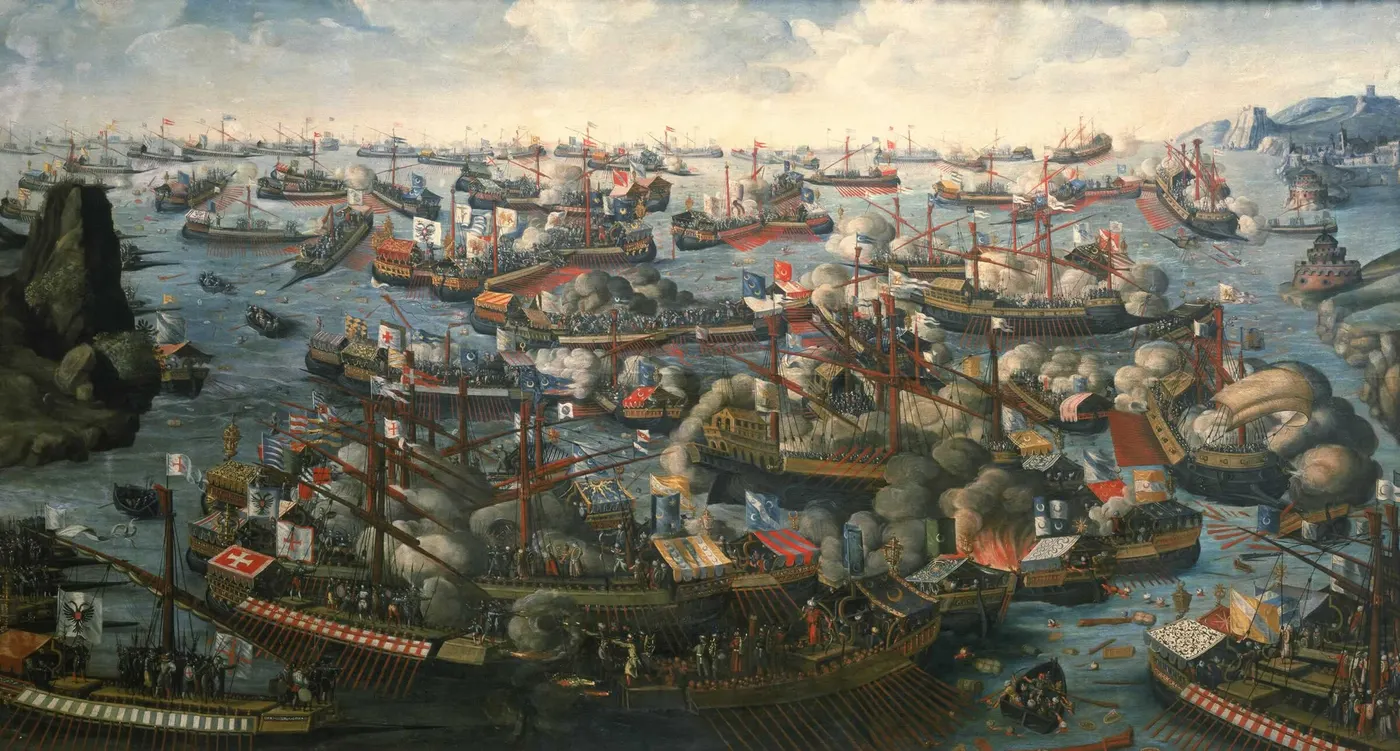
The Christian and Ottoman fleets lined up in different fashions. The Christians organized their galleys in a tightly packed line. The more experienced and powerful galleys were put at the ends and in the middle of the divisions to hold the lesser galleys together. The center held its position as the wings organized themselves. The fleet then held their position in the water, waiting as the Ottoman fleet advanced, preparing to accept the charge. The Ottoman fleet organized it self in its traditional crescent moon formation, though the shape was less pronounced than usual in this case. The major difference between the deployments of the battle then, since the crescent was not very pronounced, was the spacing of the Ottoman ships. They were lined up in two lines that were staggered in such a way that the whole line could be expanded and contracted easily, according to the necessities of the battle. This organization suited their battle tactic perfectly, since they hoped to rush and surround the enemy with a swarm of ships. The alignment of the Holy Leagues fleet was also well suited for their battle plan: receiving such a rush. The faulty intelligence on which the Ottomans based their battle plan no doubt encouraged their battle plan. Under the impression that they were facing an enemy of half their number, a swarming rush would be a logical tactical choice. It turned out to be less effective against the tightly packed Holy League, whose concentrated firepower dealt out heavy blows throughout the battle.
This battle can be logically split into three sections, the center, the northern flank, and the southern flank. The Ottomans charged on all fronts and tried to outflank to the north and south to eventually surround the Holy League. The Venetian galleases, two of which had been towed in front of each section of the Holy Leagues fleet (except the southern one), proved their merit by interrupting the Ottoman rush. They also sank seven Turkish galleys in the first volley and many more as the Ottomans rushed across the open water between the navies.
The southern portion of the battle started before the rest. Doria, commander of the right flank of the Holy League, rushed out across the sea toward the Ottomans after emerging from the islands Khoutsilaris and Oxia with the rest of the fleet. In the process, he left the two galleases assigned to him behind. Not only was he vastly outnumbered, but the Ottomans, with their double line of galleys, had him outflanked as well. There was nothing to stop an Ottoman rush because Doria had left his galleases behind. “There was only one thing he (Doria) could do in response, which was to shadow the leading element of the Ottoman horn, while inclining away to prevent it going around, technically refusing the flank”5. Doria’s limited success in this maneuver may well be responsible for the eventual Christian victory because it kept the Ottoman south at bay and protected the rear of the Christian center. If Doria had charged, Bicheno contests that he would have been outnumbered and eventually defeated, leaving the rear of the Holy League center unprotected. Eventually, the Ottomans attacked in three phases. Each attack served to scatter the forces of the Holy League. Some tensions between the nations of the holy league came into the light as the Venetians refused to come to the aid of a North African flagship, which was, as a result, captured. The Christian right flank was eventually surrounded and crushed. There was some blame thrown around, mostly at the Venetians, some of which apparently left the battle to pursue captured vessels to loot them. Santa Cruz and the vanguard came up from the rear and drove the Ottomans back, forcing them to retreat around the island Oxia. Most of the Ottoman fleet could not make it around because of the wind, and was forced to run up on the beach, where it was taken by the Holy League center, which was by now victorious.
The battle in the center was a dumb head-butting affair. Despite the confusion that the two galleases positioned in front caused, the Ottomans, though split into smaller groups, pressed on. They focused their attack on small parts of the Christian battle line. When they came alongside the Christian fleet the superior guns of the Christian fleet proved to be overwhelming. The Spanish infantrymen provided volley after volley, keeping the Ottoman marines at bay. Don John ordered an attack on Ali Pasha’s flagship. After a long three times rebuffed and three times rekindled attack, it was taken. Ali was beheaded and his head stuck on a stake. This, combined with the striking of the Ottoman battle ensign, the Crescent moon, which had never before been taken in battle, demoralized the Ottoman center, which retreated.
To the north, the Ottoman rush succeeded in outflanking the Venetian forces. Mohammed Sirocco took advantage of the coastline that he knew well and sailed close to the rocks of the gulf of Patras. Barbarrigo was surrounded and vastly outnumbered. He fought desperately and was eventually shot by an Ottoman arrow. Other Holy Alliance ships from the reserve scrambled to his aid, and Siroccos galley was taken and his head stuck on a stake.
While the Christian fleet sailed into battle, “animated by a common faith and purpose,”6 the Ottomans came to the fight with misinformed notions of the size and power of the Holy League. Imagine, as the Ottomans rush across the gap to engage the enemy, the guns firing with “a noise unanimously likened to the crack of doom by the Spanish poets.”7 Then, after enduring the pounding of the guns, imagine that, when they engaged the enemy, they found themselves outnumbered in fighting men and guns. The style of the Ottoman war machine was numerically superiority, so the Ottoman military monster found itself in an uncomfortable position.
Admittedly, so detailed an exploration of this battle and the surrounding events may not be necessary. That being said, the proceeding pages by no means present a complete history of the battle. There is enough general history to understand the political scene of the day and to consider the parallels between that scene and today’s. The discussion of the battle goes beyond what is strictly necessary for these two things because the battle is interesting of its own right.
To consider the battle as an isolated conflict would be a grave mistake and would lead to a radically different impression of the time period. Every year both the Ottomans and the Christian states (though the scale of the Ottoman warring enterprises far surpassed that of the western European states) launched campaigns- both on land and on sea. This battle should be looked at as the climax of one such campaign. It had no real significance in the long run- the Ottoman navy was rebuilt and on the attack the very next year. This not to say that the assertion made earlier is false, this battle did stop a long string of Ottoman victories in the sense that up to this point the Ottomans had never been defeated. However, the nature of Galley warfare was such that the individual fleets were of little significance. The fact that the entire Ottoman fleet was either destroyed or captured was only a small hindrance for the Ottoman Empire, whose enormous size and economic might easily founded the production of a new fleet in time for the next seafaring—and thus naval campaigning—season.
If one considers this battle as a part of a string of similar battles, then it can be used as a case in point and the thusly-generalized situation can be compared to the modern one. For the purposes of this comparison the present situation in the Middle East is somewhat simplified. Much as a thorough study of Mediterranean history would far exceed the scope of this paper, so too would a complete discussion of the modern conflicts and tensions in the region merit a book of its own. That being said, it is still possible to study the parallels between these two struggles. However, it is important to remember that the bases of these parallels were simplified, and thus whatever conclusion one comes to after comparing the two conflicts should be judged accordingly.
As considered earlier, the circumstances that drove the Christian states to unify in 1570 pale when compared to those that the United States used to justify the invasion and subsequent occupation of Iraq. If the threat that Saddam posed to the United States was fabricated then one has to wonder why there are more United States armed forces in Iraq than there have been in any country since the Vietnam War. It should come as no surprise that Iraq is one of the most oil-rich countries in the world. The United States, by far and away the largest consumer of oil in the world, might therefore have an alternate motive for occupying Iraq; that our president has all sorts of shady financial connections to various oil companies ought to heighten such suspicions.
Note that none of these assertions are concrete. Given that this conflict is quite modern, and as such is constantly evolving, it would be a bit rash to judge it so absolutely. I presume that one (in Santa Cruz) would have some doubts about the American occupation, however I would not be one to try to support or justify them. However, we may agree that the original clause for the invasion—relieving a dangerous man from his various super weapons (which presumably posed a threat to the United States)—has been called into serious question. This doubt is logical because it has since been found that Saddam likely had no super weapons, and, even more disturbingly, the United States government exaggerated whatever evidence they had to that effect in order to justify the war.
It is when one wonders why they would endanger United States citizens based on such fabricated evidence that the question of Iraqi oil comes up. Once again, the tricky business of generalization is upon us. Instead of focusing on whatever political and economic playing fields surround this topic, let us instead understand that it is simply a natural resource which the United States needs to function. Much as the Ottoman Empire invaded Bulgaria to surround the Black Sea and gain access to its rich forests for their shipbuilding industry, the United States seems to be securing a similar (in importance) natural resource. This is only one of many ways that the Ottoman Empire’s expansionist ways resemble the recent activities of the United States all around the world, specifically in the Middle East. The Ottoman Empire spread so quickly because their ideals and way of life appealed to many people. The Ottomans, moving into an Islamic shell, had an easy time appropriating those same territories, eventually controlling all of the southern and eastern Mediterranean. Modern American power could be attributed, in an admittedly simplified analysis, to an extension of the European supremacy of the 18th and 19th centuries. The capitalism in Europe spread to America, where it was taken to unbelievable heights, so that today America rules the world as much through economic power as through military might. Such a curious reversal of roles from the 16th century to today need not be explained; the similar circumstances that the Ottoman Empire was in and that the United States finds it self in today can shed light on some modern debates by themselves.
For example, how can one condemn anti-American unification in the Middle East when the Christian nations in Europe, faced with the remarkably similar Ottoman threat, did the same thing? I, as an American, feel odd making such a suggestion; so I will, for fear of the Patriot Act, append a qualifier: What I eventually mean to propose is should we not as a country take heed of what happened to the Ottoman Empire, the great power of its time (much like the US), and seek to be less hostile/expansive/self-serving/etc. in our foreign policy? If, after studying the history of the clash between the Ottoman Empire and the Holy League, one understands and sympathizes with Europe’s motive for unification, then a brief and simplified glance at the modern Middle East will expose a very similar situation, where unification (though it be anti-American) is understandable. Just as the Ottomans controlled both the African trade routes and the spice route to China, the United States essentially controls the modern economic world; and as the Ottomans surrounded the Black Sea for its forests, so too has the United States invaded—and I say it so bluntly because nine months after peace was declared, the country is still in the hands of the United States military—Iraq to secure its oil (since there likely were never any super weapons). It seems we, the United States are walking along the same path as the Ottoman Empire.
Even a brief glance at the fall of the Ottoman Empire would reveal that this path and its eventual end is not a desirable one. Simply considering the present condition of the remnants of this empire ought to confirm this. Rather than following in these footsteps: using our overbearing wealth and power to walk on those who cannot fight back- simply put, to slowly take over the world; should not we, the United States, use our economic and political clout to help those people and countries who are not as fortunate as us? So socialist a foreign policy may not even be a remote possibility, but one would think that the United States could at least abstain from being as self-serving and imperialistic with its power as it seems to be in Iraq.8 9
Bibliography
Barry, John; Hosenball, Mark. “What Went Wrong.” Newsweek 9 Feb. 2004.
Bicheno, Hugh. Crescent and Cross. London: Cassell, 2003.
This brief history is based on Bicheno’s book and the extensive knowledge of Ali, a good friend of mine who knows a good deal about such things.↩︎
Bicheno↩︎
Bicheno, 81↩︎
↩︎Barry, 3
Bicheno, 253↩︎
Bicheno, 245↩︎
Bicheno, 259↩︎
As noted somewhere toward the middle, the premises of this argument were somewhat simplified. The conclusions which I came to can easily be discredited and ignored by pointing out the almost childlike presentation of United States history and its present situation. However there are enough similarities between the two struggles that a comparison seems somewhat plausible. Thus, the fortune one can extract from it for the United States seems like a possibility. All I set out to do was offer an interesting parallel in an attempt to either offer historical support for whatever doubts about American actions which my esteemed reader might have, or to provide some “food for thought” for the reader who has no such doubts. Therefore, I believe the shortcomings of this argument are permissible.↩︎
Another thing to note is that the United States is under the control of a devout Christian. Whether the war between Islam (the Ottomans) and the Catholic Church ever ended is an interesting question that I leave for the reader to ponder.↩︎