Full text
In the story of Paul’s journey and shipwreck, the fulfillment of Paul’s prophecy is usually interpreted as evidence of Paul’s prophetic powers. In this light, the captain and crew, who disregarded the warning and sailed into the storm, are to blame for the shipwreck. However, when the circumstances of the night in question are analyzed, one finds that Paul is responsible for the shipwreck. If the captain and crew are thusly relieved of blame, their remarkable sailing abilities can be appreciated; after all, the boat might have been saved were it not for Paul’s interference.
In order to understand the voyage and shipwreck, one must consider the history of seafaring up to that point. The Mediterranean Sea is ideal for sea travel due to its climate, coastal layout, and accessibility. Even before the Ancient Greeks, the civilizations along its coasts have used this body of water to transport their armies, trade with other nations, and feed their populace. The ancient Greek navy was one of the most powerful of its time with their trireme representing the best that naval technology had to offer. It was not equipped, however, for the open ocean due to its low height. In sharp contrast, the Hebrews were a pastoral and agricultural people, and had no inducements to follow a seafaring life. Their land had a considerable seaboard along the Mediterranean, but the character of their coast gave little encouragement to navigation. The coastline of the land of Israel from Carmel southward has no bays and no estuaries or river-mouths to offer shelter from storm. The Dead Sea and other bodies of water however, were plied for fish. The Dead Sea itself was particularly good for shipping because of the extra buoyancy the high salinity granted, which allowed the vessels to carry more cargo. Ships were used along with fords to cross the various rivers in Palestine, including the river Jordan that, like the other major rivers, almost certainly had no bridges across it.
In the time of the New Testament sea travel became more reasonable. The Romans, whose empire now included Israel, perfected the art of sailing and used the Mediterranean to their full advantage. The ships of the time can be divided into two main categories - trade ships and war ships. Trade ships were used to carry wheat from Egypt to Rome, among other things, and were upward of 200 feet long with a capacity of 1200 tons. These ships could sail through storms relatively well. They were powered by sail, sometimes with rowers for auxiliary power. War ships were smaller, 100 feet at most, and could not withstand storms at sea. They were powered by rowers and based upon the Greek trireme. In addition there were coastal vessels, which were smaller and used for fishing and small, short-range, trade.
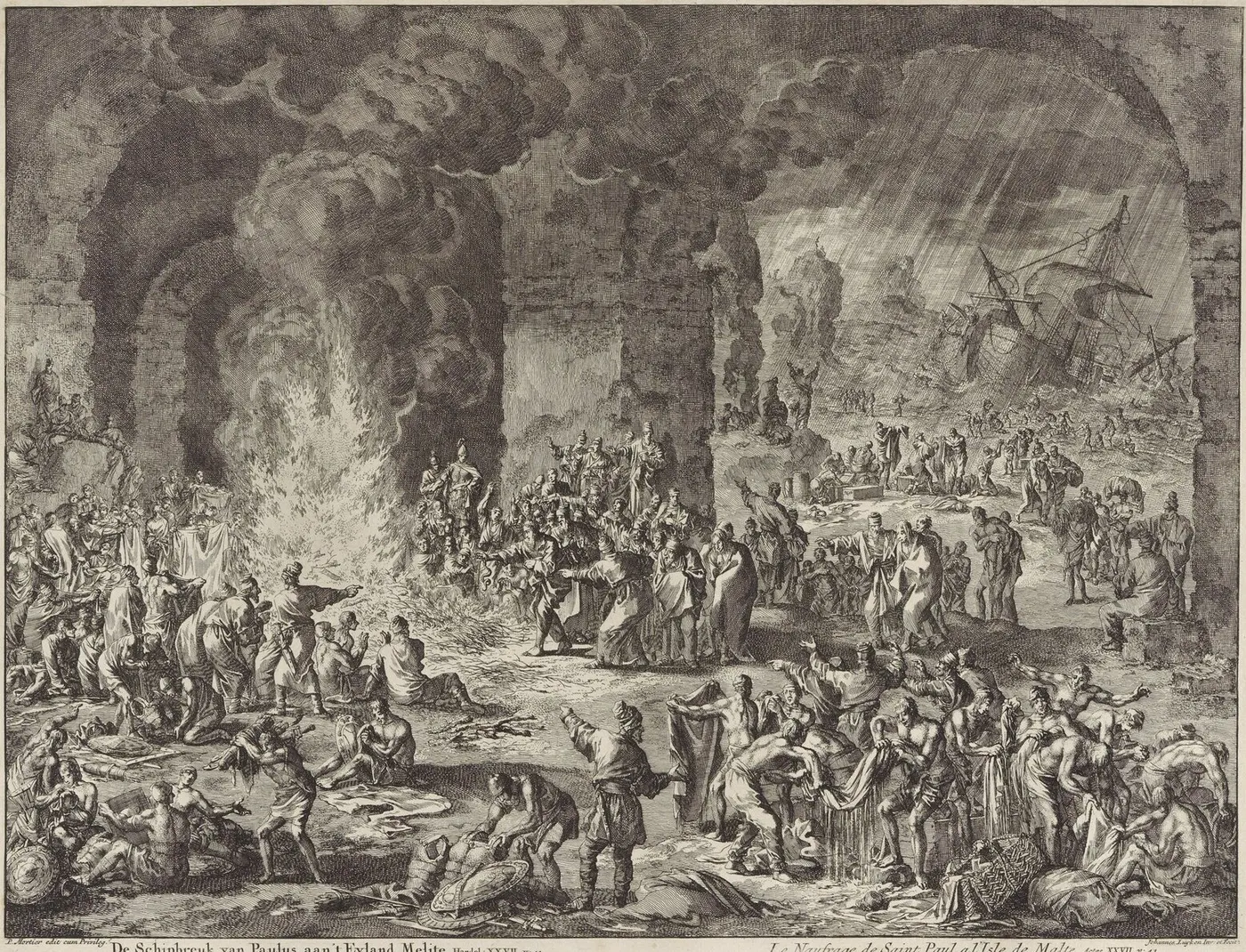
Despite the great advancements, sea travel was still very risky. Passengers were always less important than cargo. They had to bring their own provisions, which were often lost or else unpreparable because of storms and seasickness. The sailing season was short - the safest months being in the summer. While travel in the spring and autumn was possible, it was considered very dangerous. Sailing in the winter was so dangerous Roman law made it illegal to sail between November tenth and March tenth. Even in the summer, pirates and even fellow passengers complicated travel. Sea travel was certainly very risky during biblical times, although not a completely unreasonable form of transportation, largely because of the remarkable seafaring capabilities of the seamen of this era. The story of Paul’s shipwreck as told by Luke, “is considered a masterpiece- the best account to an ancient extended voyage”.1 As such it provides valuable insight. Paul and Luke were to be transferred to Rome to complete Paul’s trail, which had reached a stalemate in Caesarea. Paul was in the custody of a centurion, a roman secret-service man. They found berth on a coastal vessel to Myra, on Asia Minor. There they transferred to an Alexandrian grain ship bound for Rome. The grain ship encountered contrary winds and was forced south of Crete. There a storm hit them and they were blown south toward Cyrene (Africa). To avoid the shoals that awaited them there, the sailors managed to turn the boat toward the west despite the northerly wind, and eventually wrecked their ship upon the island of Malta. Though the shipwreck that ends Paul’s voyage could easily be blamed on the captain and his crew, a closer inspection of the circumstances place the blame on Paul.
The first leg of the journey was a slow passage north along the coast of Israel. The first port was Sidon, about forty-seven miles from Caesarea. Because of the prevailing westerly winds, the route from there went to the east of Cyprus, taking advantage of the more desirable winds caused by the wind shadow of the island. The passage was made in a coastal vessel because a larger vessel to Rome via Alexandria was unavailable. In order to reach Myra the ship hugged the coast of Asia Minor, taking advantage of the local land breezes: “At this time of year along the southern coast of Asia Minor the wind blows perpendicular to the coast (onshore during the day, offshore during the night). Thus a voyage to the west was possible despite the prevailing winds.”2 In addition, there is a westerly current along the southern shore. However, the passage was very time consuming because it was necessary to seek shelter every time the westerly winds proved too contrary for the land breeze and the current. It is estimated that the passage took fifteen days.3
Once in Myra, the prisoners, Paul and Luke included, were transferred to an Egyptian grain ship. The traditional trade route from Egypt to Rome went this way because the prevailing winds afforded the ships a straight run up the Israeli coast to Myra. “A direct sail from Egypt to Crete was very rare in autumn”4 because the vessels could not sail close enough to the wind to lay the necessary course. Myra was a large port and a valuable place to hide from the storms that became more and more frequent as the season progressed. In this ships case, it was already late September, so the northerly route was the only possible route. It followed the coast, allowing the ship to duck into a harbor if a storm should arise. Once aboard, the company set out from Myra heading west toward Cnidus (on the southwest point of Asia Minor) with wheat and 2265 people on board.
The harbor of Cnidus was a short sail from Mrya but the wind, which was now veering to the northwest, made the necessary course impossible. Thus the ship was driven down to the southern shore of Crete, where it sought refuge in a small bay called Fair Havens. “Much time had been spent, and sailing was now dangerous because fast was already over.”6 In the bay of Fair Havens, the captain, the centurion, the owner, and for some reason, Paul, held a counsel to decide what their next action should be. Paul, an inexperienced seaman, not to mention prisoner, declared, “this voyage will end with disaster and much loss, not only of the cargo and ship, but also our lives.”7 The captain and the owner considered this, but pointed out that Fair Havens, despite its appealing name, was unprotected, and thus was unsuitable for wintering and waiting out for the next sailing season. They set their eyes on Phoenix, a harbor with more protection that would be ideal for wintering and which was only a short sail away. When a favorable southern breeze arose, the boat set out and made for Phoenix.
Once the boat was clear of the Cretan mountains that protected Fair Havens from the northerly wind, a Euraquilo, a typhoon-like wind that funnels around those same mountains — exactly why sailing was so dangerous at this time of year – came down upon them. A boat such as theirs was not built well enough to head into the storm so they had no choice but to go before the wind and allow it to blow them still further south. After twenty-three miles of stormy ocean, they came upon the island of Clauda. The sailors took advantage of the brief respite its wind shadow provided to haul in the tender that they were towing behind the boat when the storm hit. The tender was now full of water and proved to be quite a chore to haul aboard. The storm continued to pick up and the boat was driven still further south by the increasing winds. Much further to the south lay the shoals of Cyrene, which had claimed countless ships, and were therefore to be avoided at all costs.
At this point the wind was veering further to the east, coming now from the northeast. The captain resolved to lower the sails and use the rigging to perform a maneuver called undergrinding, which is not completely understood. Cables were bound around the hull in some fashion in order to support the timbers and the keel. The now strengthened vessel was better equipped to face the wind and waves; and hopefully make a course away from the shoals. In addition, the crew cast all the extra equipment overboard to lighten the ship and keep it high in the water. The ship was now able to make a westerly course. As the storm progressed the wind continued to veer to the east, and the course became more northerly.
After fourteen days of stormy sailing under a cloudy sky - no stars to gauge their position by, the sailors heard the sound of breakers in the distance. The crew cast out four anchors off the stern to stop the boat after sounding the depth at fifteen fathoms and dropping. After the four stern anchors were set, the sailors conspired to escape:
And as the sailors were seeking to escape from the ship, and had lowered the boat into the sea, under the pretense of laying out anchors from the bow, Paul said to the centurion, “Unless these men stay in the ship, you cannot be saved.” Then the soldiers cut away the ropes of the boat and let it go. (Acts 27:30, 31)
If the sailors were in fact trying to escape, than Paul’s interference certainly saved the soldiers and passengers, because piloting the ship into the bay come morning would be impossible without a crew. However, we must remember that neither Paul nor Luke, the storyteller, had any knowledge of seafaring. As Conzelmann presents:
The conduct of the sailors is defended by those skilled in nautical affairs; they were certainly not planning to abandon ship. An escape at night, into the midst of the storm and the breakers, going toward an unknown shore, would have been suicidal. What we have here was a necessary maneuver—they wanted to cast out anchors from the bow as well. In the face of the prevailing wind, these had to be taken from the ship in a lifeboat … and thus secure the ship.”(Conzelmann 219)
When the morning came, the ship was lightened by dumping all the wheat. Then the four anchors were cut lose and the ship was piloted over the shoals toward the beach. However, it was caught in a current and driven to a mud bank. “The stern began to break up under the violence of the waves. With the forepeak stuck hard in the mud there was an oscillation which soon tore apart the heavily strained timbers”.8 In this passage one can see the vibrant detail that makes this story so interesting. As the ship was falling apart, those that could swim made for the shore, while those that couldn’t floated to shore on planks taken from the wrecked ship. There were no casualties.
It is important to remember that Paul and Luke were not men of the sea. Therefore we should take all of their observations with a grain of salt. For example, consider Paul’s hasty conclusion about the sailors who were lowering the lifeboat. Since Paul’s misinformed conclusion about the sailors’ actions caused the loss of the lifeboat, he is also responsible for the loss of the whole boat. Had they retained the lifeboat, then the passengers and crew could have been ferried to shore, leaving the boat outside the shoals at anchor in relative safety.9
If one entertains this suggestion, then it is possible for such a primitive vessel, with proper handling, to survive a storm that could wreck even a modern vessel. Admittedly the boat suffered serious damage and was blown wildly off course, but the fact remains that it could have survived. If the seamen are thus relieved of blame for the shipwreck, then their remarkable skills can truly be appreciated. The steps they took to prepare the ship for the storm, including undergrinding, setting out sea anchors, and lightening the vessel, all speak to their sailing ability. Also, their knowledge of the winds and currents - keeping in mind that this is before they were mapped out by survey vessels and satellites - and their ability to take advantage of them adds further credit to their seamanship. While the sea was not a kind place, and while the ships in which they set out upon it were primitive, their skill in their craft made it possible for them to bring a seemingly doomed craft through the worst of storms.